

Carried by 1 nurseries
View Availability at NurseryData provided by the participants of the Consortium of California Herbaria
View additional distribution information on the Jepson eflora
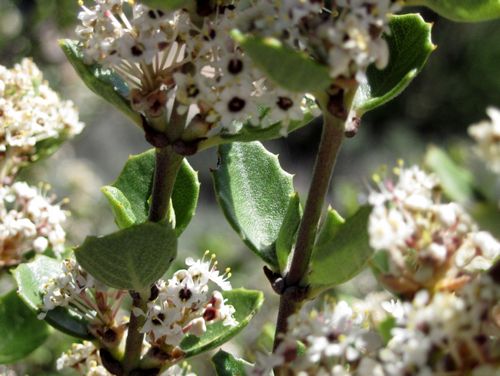
Known by the common names Mountain Buckbrush or Desert Ceanothus, it is native to the southwestern United States and northern Mexico where it grows in desert scrub, sagebrush, chaparral, and other dry habitat. This shrub grows erect to nearly 2 meters in maximum height. Its woody parts are gray in color and somewhat woolly. The evergreen leaves are oppositely arranged and variable in shape. They may be toothed or smooth along the edges. The flower cluster is a small cluster of many white flowers. The fruit is a horned capsule a few millimeters wide which bursts explosively to expel the three seeds. The seeds require thermal scarification from wildfire before they can germinate. This shrub is eagerly browsed by livestock and wild ungulates such as Mule deer and Desert Bighorn Sheep. Also known to attract a variety of bird species.
Shrub
4 - 7 ft Tall
7 ft Wide
Upright, Rounded
Moderate
Evergreen
Pleasant

Blue, White
Spring, Winter
Bank stabilization, Hedge
Full Sun
Low, Very Low
Max 2x / month once established
Moderate
Fast, Medium
Generally well drained such as decomposed granite.
Soil PH: 5.5 - 7.5
For propagating by seed: Hot water and 2-3 mos. stratification.
In the southern part of its range, it is found on dry slopes of desert transition between 3, 500 and 7, 500 ft. as part of chaparral or sagebrush scrub. In the northern part of its range, it is found with Joshua Tree woodland, Pinyon-Juniper woodland or Ponderosa pines
Chaparral, Joshua Tree Woodland, Pinyon-Juniper Woodland, Sagebrush Scrub, Yellow Pine Forest
Desert transition or plants tolerant of hot, dry inland locations such as Desert Lavender (Condea emoryi), Desert Scrub Oak (Quercus cornelius-mulleri), Big Sagebrush (Artemisia tridentata), Antelope Bush (Purshia tridentata), Desert Sage (Salvia dorii), Honey Mesquite (Prosopis glandulosa), Mojave Yucca (Yucca shidigera) and cactus species.
Butterflies and moths supported
3 confirmed and 75 likely
Bank's Emerald Moth
Chlorosea banksaria
White-streaked Saturnia Moth
Saturnia albofasciata
Hedgerow Hairstreak
Satyrium saepium