

Carried by 8 nurseries
View Availability at NurseryData provided by the participants of the Consortium of California Herbaria
View additional distribution information on the Jepson eflora
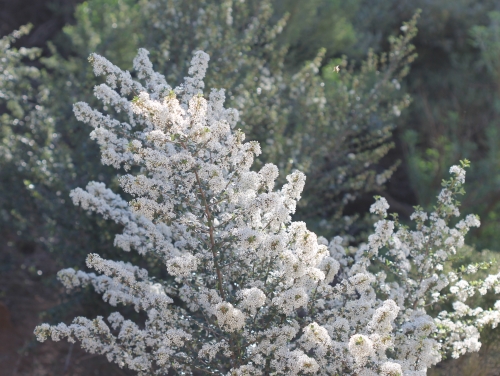
Ceanothus verrucosus is a rare species of shrub in the Buckthorn family (Rhamnaceae) known by the common names wart-stem ceanothus, barranca brush, and white coast ceanothus. It is endemic to Baja California and San Diego County, where it grows in coastal chaparral and scrub. Much of the coastal land that hosts this plant in the San Diego area has been claimed for development, but many populations still remain scattered around the region, such as one protected at Torrey Pines. This is an erect shrub approaching 3 meters in maximum height. The evergreen leaves, each up to about 1.5 centimeters long, are alternately arranged on bumpy stems. The flowers are held in a cluster up to around a foot. The flower is white except for its characteristic dark center. The fruit is a capsule about half a centimeter long.
Ceanothus verrucosus is one of the easier Ceanothus species to grow in southern California. It seems to tolerate summer water slightly better, and tolerates tough drought conditions much better than most other southern California Ceanothus species. But it does best with monthly summer water it's first year, and then left alone after that. It produces a spectacular display of white flowers in late winter, often early March. It tends to grow in an attractive fanned-out form, and its leaves stay green and healthy looking even through a long dry summer with no water.
Shrub
4 - 10 ft Tall
8 ft Wide
Fountain, Rounded
Moderate
Evergreen
Slight

Black, Cream, White
Winter, Spring
Hedge
Full Sun
Very Low
Max 1x / month once established
Easy
Tolerates cold to 30° F
Fast, Medium
Often but not always found on eroded gabbro or sandstone soils.
Soil PH: 6.0 - 7.0
Tolerant of normal pruning
For propagating by seed: Hot water; then 2-3 mos. stratification may improve germination.
32
Dry hills, mesas, canyons, marine terraces and coastal bluffs, most often found in a subtype of chaparral known as southern maritime chaparral that is found in limited locations on sandstone soils
Chaparral
Laurel Sumac (Malosma laurina), Black Sage (Salvia mellifera), Woollyleaf Ceanothus (Ceanothus tomentosus), Torrey Pine (Pinus torreyana ssp. torreyana), Del Mar Manzanita (Arctostaphylos glandulosa ssp. crassifolia), Summer Holly (Comarostaphylis diversifolia ssp. planifolia), Chamise (Adenostoma fasciculatum var. fasciculatum), San Diego Sage, Encinitas Baccharis (Baccharis vanessae), Del Mar Mesa Sand Aster, Nuttall's Scrub Oak (Quercus dumosa), Bushrue
Butterflies and moths supported
1 confirmed and 56 likely
Western Avocado Leafroller Moth
Amorbia cuneana
Common Gray
Anavitrinella pampinaria