

Carried by 17 nurseries
View Availability at NurseryData provided by the participants of the Consortium of California Herbaria
View additional distribution information on the Jepson eflora
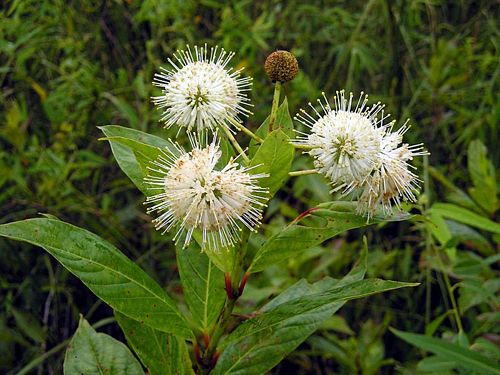
Cephalanthus occidentalis is a species of flowering plant in the coffee family, Rubiaceae, that is native to the Central Valley in California, and to eastern and southern North America. Common names include Buttonbush, Common Buttonbush, Button-willow and Honey-bells. C. occidentalis is a deciduous shrub or small tree that averages 1-3 meter (3.3-9.8 feet) in height, but can reach 6 meter (20 feet). The leaves are opposite or in whorls of three, elliptic to ovate, 7-18 centimeter (2.8-7.1 inches) long and 4-10 meter (13-33 feet) broad, with a smooth edge and a short petiole. The flowers are arranged in a dense spherical flower cluster 2-3.5 centimeter (0.79-1.4 inches) in diameter on a short peduncle. Each flower has a fused white to pale yellow four-lobed corolla forming a long slender tube connecting to the sepals. The stigma protrudes slightly from the corolla. The fruit is a spherical cluster of achenes (nutlets).
This plant is easy to grow as long as it's planted near a stream or water source. Often used in wetland revegation project in the Central Valley.
Shrub
3 - 20 ft Tall
3 - 15 ft Wide
Upright, Rounded
Fast, Moderate
Winter Deciduous

White, Cream
Summer, Fall
Deer resistant
Full Sun
Moderate
Keep moist
Easy
Tolerates cold to 10 - 20° F
Fast, Medium, Slow
Tolerates a wide variety of soils and drainage types.
Soil PH: 6 - 8
For propagating by seed: No treatment.
Edges of lakes and streams
Foothill Woodland, Mixed Evergreen Forest, Valley Grassland, Wetland-Riparian
Fremont Cottonwood (Populus fremontii), Blue Elderberry (Sambucus mexicana),Box Elder (Acer negundo), Coast Live Oak (Quercus agrifolia), Creek Dogwood (Cornus sericea)
Butterflies and moths supported
0 confirmed and 3 likely
Salt Marsh Moth
Estigmene acrea
Common Eupithacia
Eupithecia miserulata
Fall Webworm
Hyphantria cunea