

Carried by 0 nurseries
View Availability at NurseryData provided by the participants of the Consortium of California Herbaria
View additional distribution information on the Jepson eflora
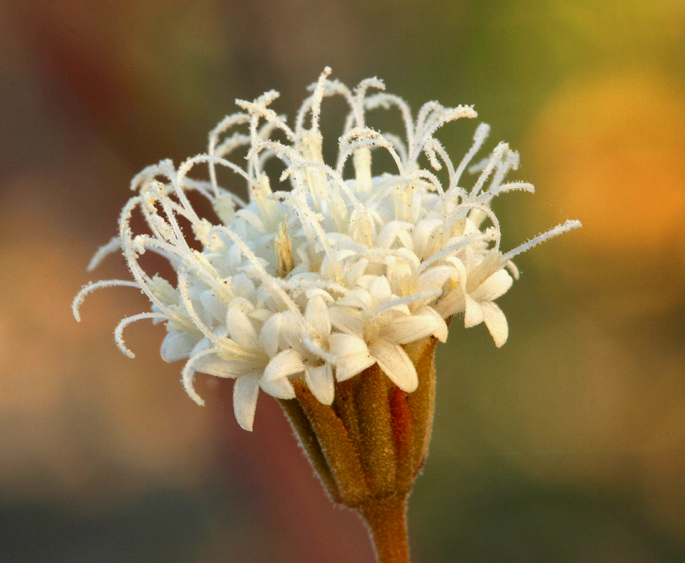
Chaenactis carphoclinia is a species of flowering plant in the daisy family known by the common name pebble pincushion. It is native to the southwestern United States and northwestern Mexico, where it grows in rocky and gravelly habitat, such as the California deserts. The species is found in southern California, Nevada, Utah, Arizona, southwestern New Mexico, Baja California, Sonora. Chaenactis carphoclinia is an annual herb growing an erect, branching stem up to about 60 centimeters (2 feet) in maximum height. The longest leaves are about 10 centimeters (4 inches) long and are usually divided into a few lobes. The inflorescence bears a few flower heads, each up to a centimeter wide. The head is lined with flat, sharp-pointed phyllaries which are reddish. The head contains several white or pink-tinted flowers with long, protruding anthers. The fruit is an achene a few millimeters in length tipped with a scaly pappus. Chaenactis carphoclinia is an annual herb growing an erect, branching stem up to about 60 centimeters (2 feet) in maximum height. The longest leaves are about 10 centimeters (4 inches) long and are usually divided into a few lobes. The inflorescence bears a few flower heads, each up to a centimeter wide. The head is lined with flat, sharp-pointed phyllaries which are reddish. The head contains several white or pink-tinted flowers with long, protruding anthers. The fruit is an achene a few millimeters in length tipped with a scaly pappus. VarietiesThere are two varieties of Chaenactis carphoclinia:C. c. var. carphoclinia is a smaller variety found throughout the species rangeC. c. var. piersonii is a larger variety known only from the Santa Rosa Mountains in southern California
Annual herb
2 ft Tall

White, Cream
Alkali Sink, Creosote Bush Scrub
Butterflies and moths supported
0 confirmed and 4 likely
Common Eupithacia
Eupithecia miserulata
Spotted Straw Sun Moth
Heliothis phloxiphaga
Fall Webworm
Hyphantria cunea
Ni Moth
Trichoplusia ni