

Carried by 1 nurseries
View Availability at NurseryData provided by the participants of the Consortium of California Herbaria
View additional distribution information on the Jepson eflora
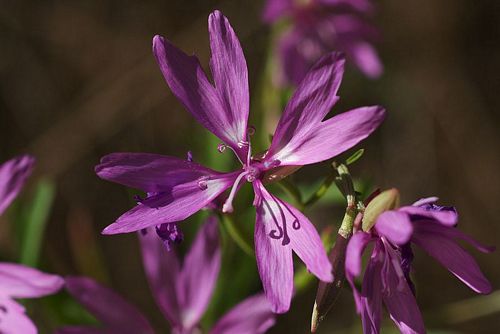
Clarkia biloba is a species of flowering plant in the evening primrose family known by the common name twolobe clarkia. It is endemic to California, where it is known from the Sierra Nevada foothills; one subspecies can also be found in the San Francisco Bay Area. It grows in chaparral and woodland habitat. It is an annual herb producing an erect stem approaching a meter in maximum height. The leaves are linear to lance-shaped and up to 6 centimeters long. Each is borne on a short petiole. The top of the erect stem is occupied by the flower cluster, which bears hanging buds above open flowers. The pink or red-purple sepals remain fused as the petals spread and emerge from one side of the bud. The petals are up to 2.5 centimeters long and pink to lavender to magenta, sometimes flecked with red. Each petal has a two-lobed tip. There are 8 stamens, some with large lavender anthers and some with smaller, paler anthers. The stigma protrudes past the stamens. There are three subspecies of this wildflower. The rarest, the Mariposa clarkia (ssp. australis), is known only from the Merced River drainage, in the Sierra foothills, where it is threatened by road maintenance and non-native plants.
Annual herb
3 ft Tall

Pink, Purple, Red
Full Sun, Partial Shade
Dry places
Chaparral, Foothill Woodland, Yellow Pine Forest
Butterflies and moths supported
0 confirmed and 5 likely
Mariposa Forester
Alypia mariposa
White-lined Sphinx
Hyles lineata
Clark's Day Sphinx Moth
Proserpinus clarkiae