

Carried by 0 nurseries
View Availability at NurseryData provided by the participants of the Consortium of California Herbaria
View additional distribution information on the Jepson eflora
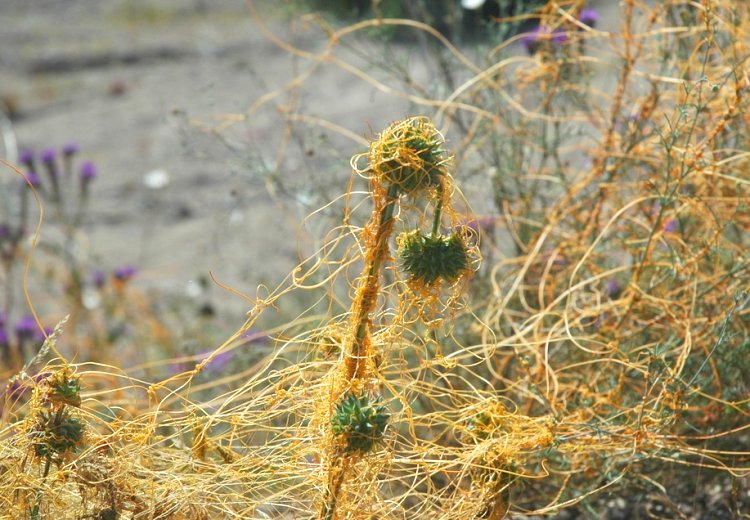
Cuscuta denticulata (desert dodder or small-toothed dodder) is a thin, yellow to orange, parasitic annual vine in the morning glory family (Convulvulaceae), native to the deserts of Southwestern America. Growth pattern. It is an annual plant that grows as a very thin orange-ish parasitic vine, with clumping twinings around the host stems. It parasitizes the host by sending small, short-lived rootlets (haustoria) into its tissues, from which it absorbs moisture and nutrients. Leaves and stems. Yellow to orange stems are without hairs, with minute scale-like leaves. Inflorescence and fruit. It blooms from May to October with tiny spikes of clusters of miniature white, 5-parted bell shaped flowers. Corolla lobes are bend back, with overlapping calyx lobes. Both calyx and corolla have fine teeth on their margins, hence the species name and common name. Fruits are conical capsules. Habitat and range. It grows up to 4,000 feet (1,200 m) in the Mojave Desert and Sonoran Desert into Baja California. It parasitizes plants of the creosote bush scrub and Joshua tree woodland communities, such as creosote bush (Larrea tridentata) and cheesebush (Ambrosia salsola).
Annual herb, Vine

Yellow, White, Orange
Creosote Bush Scrub, Joshua Tree Woodland
Butterflies and moths supported
0 confirmed and 1 likely
The Brown Elfin
Callophrys augustinus