

Carried by 16 nurseries
View Availability at NurseryData provided by the participants of the Consortium of California Herbaria
View additional distribution information on the Jepson eflora
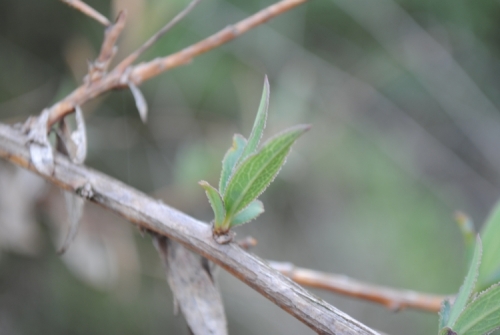
Bush Poppy (Dendromecon rigida) is an attractive compact shrub native to California and Baja California. It is covered in petite, buttercup-like yellow flowers during the winter-spring blooming season. Bush Poppy is a fast-growing shrub that maintains a rounded form with light pruning. The Bush Poppy?s narrow, grayish-green leaves are evergreen, providing year-round color in the landscape, even when not in bloom.
This plant is robust and easy to grow when planted in the right dry, sunny conditions. It is commonly found on dry, rocky slopes and is known to be a fire-following plant. In the garden, it does best when planted in full sun in very well-draining soil. The Bush Poppy needs little to no supplemental irrigation once it is established, making it an appealing choice for a waterwise garden.
Shrub
3 - 10 ft Tall
2 - 8 ft Wide
Rounded
Fast, Moderate
Evergreen
Slight

Yellow
Winter, Spring
Full Sun
Very Low
Max 1x / month once established
Tolerates cold to 0 - 10° F
Fast
Well drained soils, typically on a slope. Tolerant of clay only if given no water after established.
Tolerates serpentine soil..
Soil PH: 6 - 8
Can handle light trimming after blooming but does not tolerate a heavy pruning. Interestingly though, it is very fire-resistant, and is considered a "fire follower", resprouting from the base after the top growth has been completely burnt down from a wildfire.
For propagating by seed: Fire treatment or 2 mos. stratification (Emery and Frey 1971). 3 mos. stratification with a diurnal fluctuation from 46° to 70°F may improve germination. More easily propagated from stem cuttings in winter with intermittent mist and bottom heat.
4, 5, 6, 7*, 8*, 9*, 10, 11, 12, 14*, 15*, 16*, 17, 18*, 19*, 20*, 21*, 22*, 23*, 24*
Dry slopes and flats in chaparral and openings in mixed evergreen forest.
Chaparral
Eastwood Manzanita (Arctostaphylos glandulosa ssp. glandulosa), Bigberry Manzanita (Arctostaphylos glauca)
Butterflies and moths supported
1 confirmed and 0 likely
Schmidt, M.G, Greenberg, K.L. (2012). Growing California Native Plants (2nd ed.). University of California Press,