

Carried by 24 nurseries
View Availability at NurseryData provided by the participants of the Consortium of California Herbaria
View additional distribution information on the Jepson eflora
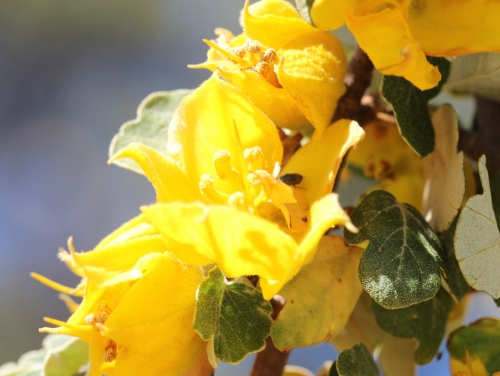
Best known for its spectacular bright yellow flowers during spring blooming season, Flannel Bush (Fremontodendron californicum) is an eye-catching large evergreen shrub. The vibrant blooms attract bees and butterflies. This plant gets its name from fuzzy hairs that cover its leaves. These hairs can be an irritant to eyes and skin.
Flannel Bush has unique moisture and site-selection requirements. In its natural environment, it grows in sandy or chalky soil, about 10 feet away from a water source. In the garden, plant it at a similar distance from any type of irrigation. It is fast growing, and under ideal conditions, it can reach 20 feet tall and 20 feet wide in five years.
It is notably intolerant of summer water and should stay dry, even when it looks like it needs water. Supplemental irrigation that's too close to a Flannel Bush can kill it. This plant depends on its long roots to reach moisture at a distance, so be sure to plant it near other low-moisture plants.
Shrub
6 - 20 ft Tall
20 ft Wide
Upright, Mounding, Rounded, Spreading, Upright Columnar
Fast, Moderate
Evergreen
None, Slight

Yellow, Orange
Summer, Spring
Hedge
Full Sun
Low
Never irrigate once established
Moderate
Tolerates cold to 20° F
Fast
Sandy, gravelly, rocky or chalky, very well draining soils.
Tolerates serpentine soil..
Soil PH: 6 - 8
Avoid hard pruning. Cutting into the wood will often kill this plant..
Seeds normally require fire to germinate in nature, but it can also be germinated by soaking in boiling hot water then refrigerating for 3 months before planting.
4, 5, 6, 7*, 8*, 9*, 10, 11, 12, 14*, 15*, 16*, 17*, 18*, 19*, 20*, 21*, 22*, 23*, 24*
Dry sandy washes or fast-draining rocky or chalky hill sides. Near the coast, it is found in chaparral. In inland mountains, it may be found as part of yellow pine (Ponderosa) woodland. In more arid high desert areas, it may occur with pinon/juniper woodland.
Chaparral, Oak Woodland
California Sycamore, Blue Elderberry (Sambucus mexicana), Oak, Manzanita species
Butterflies and moths supported
1 confirmed and 2 likely
White-streaked Saturnia Moth
Saturnia albofasciata
Northern White-Skipper
Heliopetes ericetorum