

Carried by 14 nurseries
View Availability at NurseryData provided by the participants of the Consortium of California Herbaria
View additional distribution information on the Jepson eflora
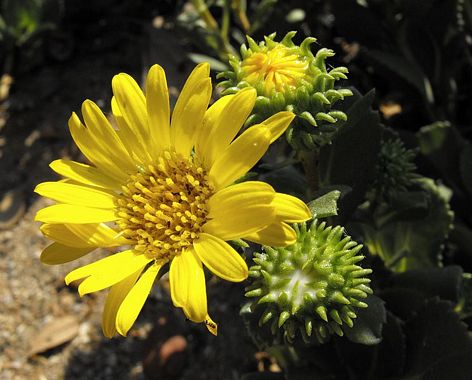
Gumweed (Grindelia stricta var. platyphylla) is a native perennial herb that grows in Southern and Central California, primarily in the Central Coast region. It is a member of the Asteraceae and has typical sunflower floral structure with yellow disk flowers and ray flowers. It tends to grow in tidal flats, coastal strand, and coastal sage scrub typically very near the ocean, at elevations from 0-700 feet. There are three recognized varieties of Grindelia stricta; var. platyphylla is broadly distributed along the coast from Del Norte County to Los Angeles County and the northern Channel Islands. The flower bud is distinctive in having large amount of sticky white sap which native people use as an adhesive. The plant has a prostrate, sprawling habit and roots as it spreads. It performs best in coastal gardens with sandy soil.
Perennial herb
1 - 2 ft Tall
7 ft Wide
Spreading
Moderate
Evergreen
None

Yellow
Spring, Summer, Fall
Deer resistant, Groundcover, Lawn alternative
Full Sun, Partial Shade
Low, Moderate
Max 3x / month once established
Easy
Tolerates cold to 30° F
Fast
Mostly sandy.
Tolerates saline soil..
Soil PH: 5.0 - 7.5
Deadhead to encourage flowering
Rooted cuttings
5, 7, 8, 9, 14*, 15, 16, 17*, 19, 20, 21, 22*, 23*, 24
Tidal flats, marshes, dunes, seabluffs and coastal strand where it receives extra moisture from fog and sea spray. Also occurs in coastal sage scrub in more upslope areas
Coastal Sage Scrub, Coastal Salt Marsh, Coastal Strand, Wetland-Riparian
Other coastal plants such as Sand Verbena (Abronia spp.), Silver Beachweed (Ambrosia chamissonis), Beach Sage (Artemisia pycnocephala), Morningglory (Calystegia spp.), Beach Evening Primrose (Camissoniopsis cheiranthifolia), Seaside Daisy (Erigeron spp.), Lupine (Lupinus spp.), Hummingbird Sage (Salvia spathacea), Penstemon species.
Butterflies and moths supported
0 confirmed and 10 likely
Orange Tortrix Moth
Argyrotaenia franciscana