

Carried by 42 nurseries
View Availability at NurseryData provided by the participants of the Consortium of California Herbaria
View additional distribution information on the Jepson eflora
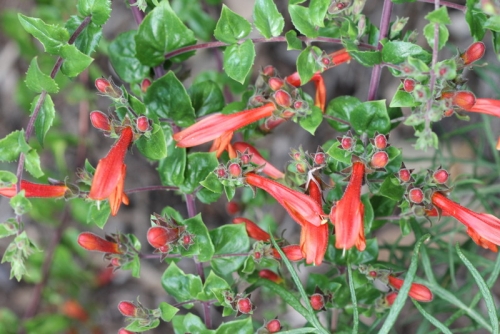
Climbing penstemon (Keckiella cordifolia), also known by its former name Penstemon cordifolius, is a vibrant flowering shrub prized for its striking blooms and rich foliage. The tubular flowers range from pale orange to deep scarlet and appear from spring through summer, creating a stunning display that attracts hummingbirds, butterflies, and other pollinators. The oval to heart-shaped dark green leaves add a lush appearance, although the foliage typically drops in summer.
This sprawling shrub can reach over 6 feet tall and spread 3 to 6 feet wide. It thrives in shady slopes in hotter inland regions, while cooler coastal areas allow it to flourish in full sun. Climbing Penstemon is drought-tolerant once established and adapts well to various soil types, making it a versatile choice for native gardens. Additionally, it serves as a host plant for several species of butterflies and moths, further enhancing its ecological value.
Shrub
3 - 7 ft Tall
3 - 6 ft Wide
Rounded, Spreading
Fast
Summer Deciduous, Summer Semi-deciduous
Slight

Red
Summer, Spring
Containers, Deer resistant
Full Sun, Partial Shade
Very Low, Low
Max 1x / month once established
Moderate
Tolerates cold to 0 - -5° F
Fast, Medium, Slow
Adaptable.
Soil PH: 6 - 8
For propagating by seed: No treatment.
7, 8, 9, 14*, 15*, 16*, 17*, 18*, 19*, 20*, 21*, 22*, 23*, 24*
Rocky, well drained slopes with chaparral, often in shade, in the southern part of the state and the coastal side of the mountain ranges
Chaparral
Chamise (Adenostoma fasciculatum var. fasciculatum), Woolly Bluecurls (Trichostema lanatum), White Sage (Salvia apiana), California Buckwheat (Eriogonum fasciculatum var. fasciculatum), California Coffeeberry (Frangula californica ssp. californica), Toyon (Heteromeles arbutifolia), Lemonade Berry (Rhus integrifolia), Coastal Prickly Pear Cactus, Manzanita species, Yucca spp.
Butterflies and moths supported
1 confirmed and 2 likely