

Carried by 7 nurseries
View Availability at NurseryData provided by the participants of the Consortium of California Herbaria
View additional distribution information on the Jepson eflora
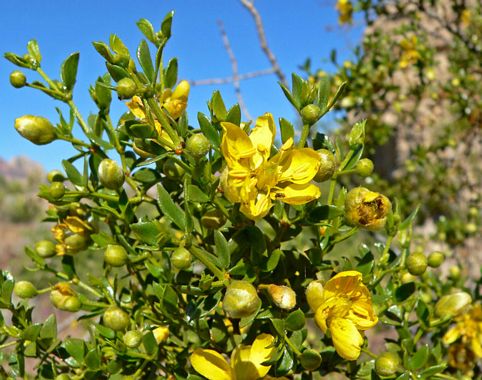
Creosote bush (Larrea tridentata) is an evergreen flowering shrub, prominent in the deserts of western North America. It is slow-growing, with dark green leaves and the yellow flowers blooming in spring. The whole plant exhibits a characteristic odor of creosote (especially when wet), from which the common name derives.
This plant takes full sun and is extraordinarily tolerant of drought, due to its deep root system. It prefers well-draining, rocky soil but tolerates saline or alkaline soils. It reproduces by seed and also by sending up new shoots from the roots. The latter results in the creation of clonal rings, some of which are among the oldest known plants at around 11,000 years old. Galls may form by the activity of the creosote gall midge. The plant's dramatic shape can look striking in front of a wall or other simple background. It can be pruned in late summer or early winter.
Numerous insects are attracted to the flowers. Various birds are attracted to the seeds.
Shrub
3 - 12 ft Tall
6 - 12 ft Wide
Moderate, Slow
Evergreen
Pleasant

Yellow
Spring
Hedge
Full Sun
Low, Very Low
Max 1x / month once established
Moderate
Tolerates cold to 10° F
Fast
Almost always found in rocky, sandy or gravelly soil.
Tolerates saline soil.,Tolerates sodic soil..
Soil PH: 6.5 - 8.5
Prune to shape in late fall or early winter
For propagating by seed: Soak, preferably in distilled water, overnight; germinate in dark under hot bed conditions (optimum temperature 73°F constant). Germination percentage may be low. Germinating seedlings intolerant of water stress [Barbour 1968; Mabry et al. 1977).
7, 8*, 9*, 10*, 11*, 12*, 13*, 14*, 18, 19*, 20*, 21*, 22, 23
Mountains, valleys, and washes of the southern California deserts
Creosote Bush Scrub
Desert Willow (Chilopsis linearis), Desert Lavender (Condea emoryi), California Fan Palm (Washingtonia filifera), Ocotillo (Fouquieria splendens), Jojoba (Simmondsia chinensis), Blue Paloverde (Parkinsonia florida), White Bursage (Ambrosia dumosa), Chuparosa (Justicia californica), Barrel Cactus (Ferocactus cylindraceus), Desert Agave (Agave deserti), Brittlebush (Encelia farinosa), Indigo Bush (Psorothamnus spp.), Smoke Tree (Psorothamnus spinosus), Apricot Mallow (Sphaeralcea ambigua), Opuntia spp., numerous annual wildflowers
Butterflies and moths supported
1 confirmed and 2 likely