

Carried by 0 nurseries
View Availability at NurseryData provided by the participants of the Consortium of California Herbaria
View additional distribution information on the Jepson eflora
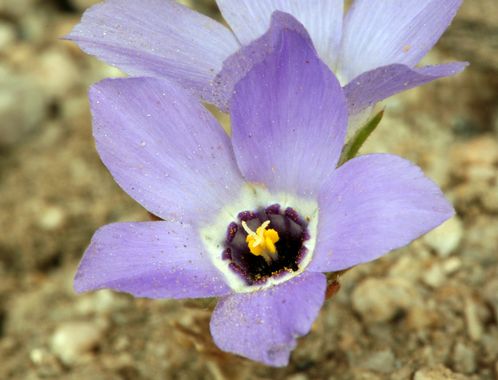
Linanthus parryae is a species of flowering plant in the phlox family known by the common name sandblossoms. It is endemic to California, where it is known from sandy, open habitat types in several regions from the Central Valley to the Sierra Nevada foothills to the Mojave Desert. This is a petite annual herb producing short stems just a few centimeters tall surrounded by hairy, needle-lobed leaves. The flower cluster, which often appears to sit directly on the ground tucked amidst the leaves, is a cluster of funnel-shaped flowers about a centimeter wide. The flower may be white or blue, with some populations made up of both colors. This uncommon phenomenon has made this species a model organism in studies of genetic variation. For many decades a long line of geneticists and botanists, including Sewall Wright, Carl Epling, and T. G. Dobzhansky, have studied populations of this flower to determine the factors that influence this polymorphism. Color frequencies may vary for many reasons, including genetic drift and pure natural selection. Wright built his theories on genetic drift using data he collected on this flower in the Mojave Desert. More recent studies place greater emphasis on the effects of natural selection on color frequency.
Annual herb
1 - 4 in Tall

Purple, Lavender
Spring
Full Sun
Low
Fast
Sandy, open places, flat places
Creosote Bush Scrub, Joshua Tree Woodland
Butterflies and moths supported
0 confirmed and 2 likely
Three-striped Longhorn
Adela trigrapha
Buckwheat Borer Moth
Synanthedon polygoni