

Carried by 47 nurseries
View Availability at NurseryData provided by the participants of the Consortium of California Herbaria
View additional distribution information on the Jepson eflora
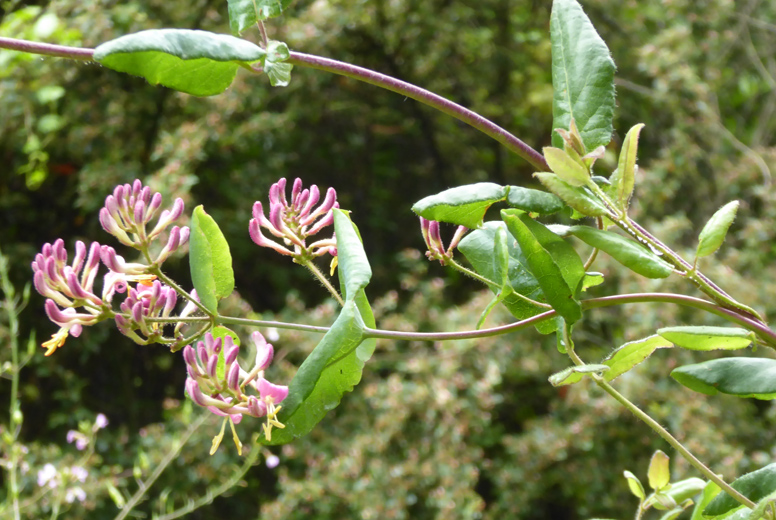
Pink honeysuckle, (Lonicera hispidula) also known as California honeysuckle, is a native vine or shrub in the Caprifoliaceae family. It grows along the coast from San Luis Obispo County northward, as well as in the Sierra foothills and parts of southern California. Typically found on slopes and streambanks at elevations up to 2,500 feet, this adaptable plant thrives in both moist year-round soils and drier summer conditions with minimal irrigation.
With its vibrant tubular pink flowers, pink honeysuckle is a magnet for hummingbirds. It can climb larger shrubs or trellises when available, or it will sprawl along the ground as a trailing shrub. In late summer, it produces clusters of striking red berries that attract birds, though they may be mildly toxic to humans.
Gardeners should be aware that pink honeysuckle can act as a foliar host for the pathogen Phytophthora ramorum, which causes sudden oak death. While it remains a beautiful and easy-to-grow choice for coastal and northern California gardens, care should be taken when planting near susceptible oak species.
Shrub, Vine
4 ft Tall
8 ft Wide
Spreading
Fast
Winter Deciduous
Slight

Pink
Summer, Spring
Containers, Deer resistant
Partial Shade
Very Low, Low
Max 1x / month once established
Easy
Tolerates cold to -5° F
Medium, Slow
Tolerates a variety of soils including clay.
Soil PH: 5.0 - 7.0
For propagating by seed: 1mo. stratification. For propagating by seed: 1mo. stratification.
7*, 8, 9, 14*, 15, 16, 17, 18, 19, 20, 21, 22, 23, 24
Slopes and streambanks, protected canyons, foothills
Douglas-Fir Forest, Foothill Woodland, Mixed Evergreen Forest, Forest
Use with Snowberry (Symphoricarpos mollis), Hummingbird Sage (Salvia spathacea), Hollyleaf Redberry (Rhamnus ilicifolia), Toyon (Heteromeles arbutifolia), Oak (Quercus spp.), Douglas Fir (Pseudotsuga menziesii), Pines (Pinus spp.), and others
Butterflies and moths supported
2 confirmed and 22 likely
Geranium Plume Moth
Amblyptilia pica
Western Avocado Leafroller Moth
Amorbia cuneana