

Carried by 1 nurseries
View Availability at NurseryData provided by the participants of the Consortium of California Herbaria
View additional distribution information on the Jepson eflora
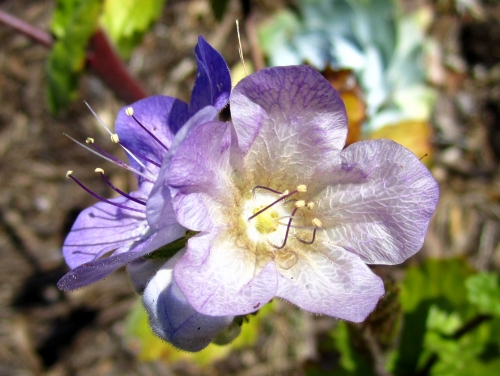
Phacelia grandiflora is a species in the Boraginaceae known by the common name largeflower phacelia. It is native to the coastal hills and mountain ranges of southern California and Baja California, where it grows in coastal sage scrub, chaparral, and other local habitats, especially areas recently cleared by wildfire. It is an annual herb with a branching or unbranched erect stem reaching one meter in maximum height. It is hairy and coated in soft and stiff hairs. The leaves are up to 20 centimeters long with toothed, rounded or oval blades borne on long petioles. The large, hairy flower cluster is a one-sided curving or coiling cyme of widely bell-shaped flowers. Each flower is 2.5-4 centimeters wide and purple to blue in color, usually with a paler throat. The seeds germinate readily and the plant requires little care. Its height and long flowering season make it a standout in the dry garden.
Annual herb
1 - 3 ft Tall
Upright Columnar
Fast
Pleasant

Blue, Lavender, Purple
Winter, Spring
Full Sun
Low
Max 2x / month once established
Moderate
Tolerates cold to 15° F
Fast, Medium
Typically sandy and/or rocky.
By seed, no treatment required. For propagating by seed: No treatment may give some germination. Addition of a small amount of charate over the sown seeds greatly improves germination (Keeley and Keeley 1982).
14*, 15*, 16*, 17*, 18*, 19*, 20*, 21*, 22*, 23*, 24*
Open sandy places, especially those that have recently burned, in the vicinity of the coast of southern California
Chaparral, Coastal Sage Scrub
Chamise (Adenostem fasciculatum), San Diego County Viguiera (Bahiopsis laciniata), Manzanita (Arctostaphylos spp.), Coastal Sagebrush (Artemisia californica), Coyote Brush (Baccharis pilularis), Ceanothus species, Common Sandaster (Corethrogyne filaginifolia), Dudleya species, California Fuchsia (Epilobium canum), Buckwheat (Eriogonum spp.), Mexican Flannelbush (Fremontodendron mexicanum), Tecate Cypress (Hesperocyparis forbesii), Lupinus species, Penstemon species, Bladderpod (Peritoma arborea), Oaks (Quercus spp.), Matilija Poppy (Romneya coulteri), White Sage (Salvia apiana), Woolly Bluecurls (Trichostema lanatum), Yucca species, cactus species, as well as other annuals such as California Poppy (Eschscholzia californica).
Butterflies and moths supported
0 confirmed and 9 likely
Geranium Plume Moth
Amblyptilia pica
Oso Flaco Flightless Moth
Areniscythris brachypteris
Orange Tortrix Moth
Argyrotaenia franciscana