

Carried by 60 nurseries
View Availability at NurseryData provided by the participants of the Consortium of California Herbaria
View additional distribution information on the Jepson eflora
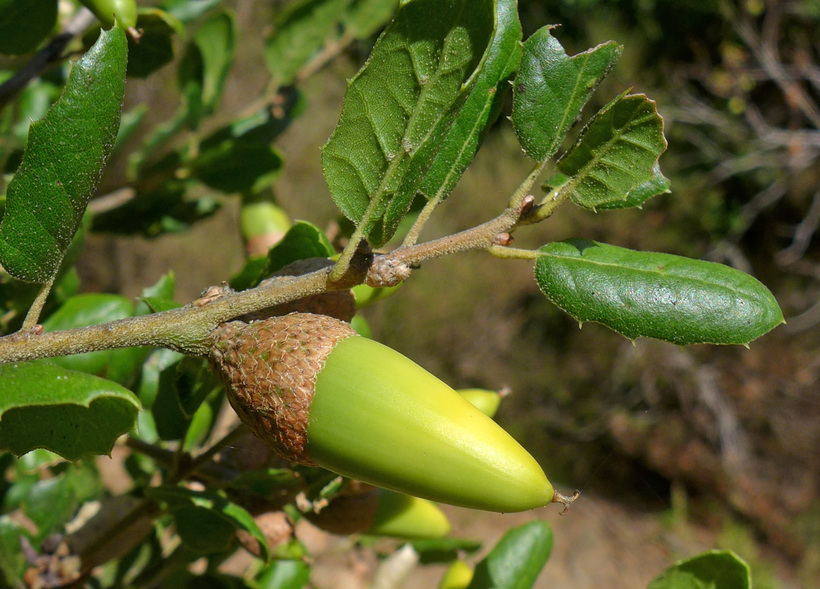
The Coast Live Oak (Quercus agrifolia) is an iconic, majestic tree that serves as a cornerstone for wildlife and the surrounding ecosystem. It is easily-recognized by its gnarled branches and grand canopy. The Coast Live Oak flowers each spring and its acorns attract a wide variety of birds and butterflies - over 270 species rely on these trees for habitat and food.
With its rich green foliage and unique branching pattern, the Coast Live Oak is a favored choice for both residential and commercial landscapes. These resilient trees can live for centuries, often surpassing 250 years, and can grow impressively tall, reaching mature heights ranging from 30 to 80 feet.
It is one of the only California native oaks that thrives in coastal environments, it enjoys fog and mild winters. In the first year after planting, water once a week. Then, reduce it to once a month until it reaches about 10 feet tall. After that, avoid watering directly during summer.
Coast Live Oaks like to have their roots shaded. When they're young, surround them with mulch, rocks, or smaller native plants. Some California natives, such as Toyon and Manzanitas, do well as "understory" plants under the Coast Live Oak. Fallen oak leaves provide natural mulch for the tree. Don't fertilize oaks. They'll amend the soil over time with their own leaves and build the natural mycorrhizal fungus in the soil they need to thrive. Gradually, they become islands of natural fertility that improve the health of the nearby plants.
Tree
25 - 82 ft Tall
15 - 35 ft Wide
Rounded
Moderate, Slow
Evergreen
None

Yellow, Green, Cream
Spring, Winter
Bank stabilization, Hedge
Full Sun, Partial Shade
Very Low, Low, Moderate
Max 1x / month once established
Easy
Tolerates cold to 15° F
Medium
Tolerates a variety of soils but prefers a deep, well draining loam which it usually develops over time from leaf drop.
Soil PH: 4.0 - 8.0
Best to prune during July or August, when the trees are not normally growing, and when the dry weather is less likely to support pathogens that may attack the wounds. As much as possible, avoid pruning large limbs as this exposes the tree to possible infection and can take many years to recover. Avoid over-thinning interior branches or "lion tailing."
Propagation by acorns is relatively simple. Best acorns sink in water, have a more or less even mix of green, yellow and brown color, and pop out of their caps easily. Plant acorns on their sides, at depth of 1.5x its diameter. Keep moist until germinated and at least 3-4 weeks after the seedling pushes out of the ground. For propagating by seed: Fresh seeds sow in fall outdoors or stratify to hold for spring sowing. (USDA Forest Service 1974).
Coast live oak occurs in a number of natural settings over a large part of the state, usually below 3, 000 ft.. It is often seen in valleys and slopes near (but not in) streams where it is the dominant species in live oak woodland. Chaparral or coastal sage scrub are frequently upslope, with riparian vegetation in the stream. In other areas it is found among numerous other tree species (including other oak spacies) as part of foothill woodland or mixed evergreen forest. It is occasionally found in native grassland savannahs.
Foothill Woodland, Southern Oak Woodland
A wide variety of species work as either understory or companion plants with Coast Live Oak, including Coyote Brush; California Buckwheat; Coast Sagebrush; Toyon; California Coffeeberry; Woolly Bluecurls; Snapdragon Penstemon; Fuchsiaflower Gooseberry; California Wildrose; Manzanita spp.; Ceanothus spp.; Salvia spp. and annual wildflowers
Butterflies and moths supported
41 confirmed and 122 likely
California Sister
Adelpha californica
Polyphemus moth
Antheraea polyphemus
Fruit-Tree Leafroller Moth
Archips argyrospila
Orange Tortrix Moth
Argyrotaenia franciscana
Waterwise Garden Planner. “Quercus agrifolia.” Accessed April 1, 2025. https://waterwisegardenplanner.org/plants/quercus-agrifolia/.