

Carried by 28 nurseries
View Availability at NurseryData provided by the participants of the Consortium of California Herbaria
View additional distribution information on the Jepson eflora
Scrub Oak plays a vital role in supporting biodiversity by attracting birds and a diverse range of butterflies. Its ability to thrive in various conditions and benefits to local wildlife make it a valuable addition to gardens.
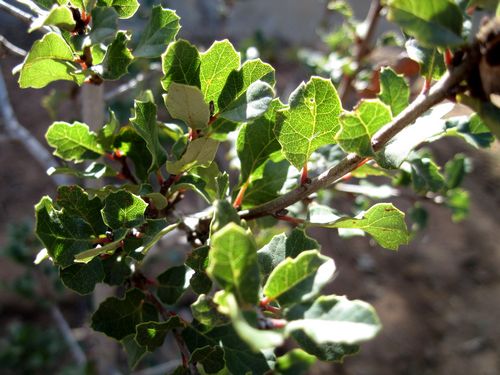
It is a medium-to-small oak. Its green leaves are leathery on the surface and somewhat hairy on the underside. Scrub Oak is a versatile plant that thrives in full sun to part shade. In cooler regions, it remains compact, while in warmer areas, it spreads out and grows several meters high.
Scrub Oak benefits from a thick layer of oak leaves as mulch with a few large rocks. Refrain from summer watering to mimic its natural drought-tolerant adaptation.
Tree, Shrub
15 - 20 ft Tall
15 ft Wide
Rounded
Slow
Evergreen
None

Cream, Green, Yellow, Brown
Winter, Spring
Bank stabilization, Hedge
Full Sun, Partial Shade
Low, Very Low
Max 1x / month once established
Easy
Tolerates cold to 20° F
Fast, Medium
Most often found on eroded granite or sandstone soils.
Soil PH: 6.0 - 8.0
By acorns. For propagating by seed: Fresh seeds sow in fall outdoors or stratify to hold for spring sowing. (USDA Forest Service 1974).
5, 7*, 8, 9, 10, 14*, 15*, 16*, 17, 18*, 19*, 20*, 21*, 22*, 23*, 24*
Dry slopes, canyons, foothills, marine terraces, from coast to inland, mostly below 5, 000 ft from Shasta County to San Diego County and into Baja California, Mexico.
Chaparral, Coastal Scrub, Lowland Chaparral, Southern Coastal Scrub
Toyon (Heteromeles arbutifolia), Chamise (Adenostoma fasciculatum var. fasciculatum), Laurel Sumac (Malosma laurina), Heartleaf Penstemon, White Pitcher Sage (Lepechinia calycina), Woolly Bluecurls (Trichostema lanatum), Tree Poppy, Ceanothus spp., Manzanita species
Butterflies and moths supported
0 confirmed and 165 likely