

Carried by 21 nurseries
View Availability at NurseryData provided by the participants of the Consortium of California Herbaria
View additional distribution information on the Jepson eflora
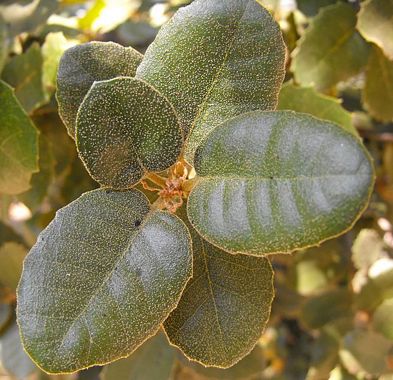
Island oak (Quercus tomentella), also known as island live oak or channel islands oak, is an evergreen tree in the Oak family (Fagacea). A smaller oak tree in stature, the leaves are hairy (tomentose) on the upper and lower surfaces, toothes, and large compared to other oaks. Young twigs are also hairy, yet mature bark is gray and furrowed. Mature acorns have rounded tips and are also quite large compared to other species.
Endemic (limited) to six islands off the coast of California, it is also federally listed as a rare species because of its limited distribution in the wild. Island oak's natural habitat is Island canyons, slopes and bluffs. Oak trees support a larger number of wildlife than any type of tree in our state. Multiple mammals, birds, amphibians, and pollinators use oak trees for food and shelter. Indigenous People ground the acorns to make flour, after leaching out the tannins; they may also have roasted and ground them and used it as a coffee alternative.
In the garden it is fast growing and trouble-free. It is best used near the coast, but can tolerate inland conditions within about 20 miles of the coast if given some protection and a little extra water during dry times, especially when the young plant is getting established. The large leaves and dense shade create unfavorable conditions for understory plants; plant island shrubs and perennials with similar growing conditions next to it, rather than under it for better results.
Tree
33 - 66 ft Tall
35 ft Wide
Rounded, Upright Columnar
Fast, Moderate
Evergreen

Cream, Green
Spring, Summer
Bank stabilization, Hedge
Full Sun, Partial Shade
Low
Max 2x / month once established
Moderate
Tolerates cold to 15° F
Medium
Tolerates a wide variety of soils, including very rocky conditions.
Soil PH: 6.0 - 7.2
For propagating by seed: Fresh seeds sow in fall outdoors or stratify to hold for spring sowing. (USDA Forest Service 1974).
5, 7, 8, 9, 14*, 15*, 16*, 17*, 19*, 20*, 21*, 22*, 23*, 24*
Slopes, bluffs and canyons of the Channel Islands where fog is frequent
Chaparral, Closed-cone Pine Forest, Foothill Woodland
Due to its relative large leaves and dense foliage, it often has no understory. However, it can be used adjacent to many other island plants such as Santa Cruz Island Ironwood (Lyonothamnus floribundus ssp. asplenifolius), Catalina Cherry (Prunus ilicifolia ssp. lyonii), Island Bristleweed (Hazardia detonsa), Redflower Buckwheat (Eriogonum grande var. rubescens), Island Snapdragon (Gambelia speciosa), and Giant Coreopsis (Leptosyne gigantea). Other chaparral and sage scrub companions include California Encelia (Encelia californica), California Sagebrush (Artemisia californica), Bladderpod (Peritoma arborea), and Ceanothus spp.
Butterflies and moths supported
1 confirmed and 30 likely
California Sister
Adelpha californica
Orange Tortrix Moth
Argyrotaenia franciscana
Ilia Underwing
Catocala ilia