

Carried by 4 nurseries
View Availability at NurseryData provided by the participants of the Consortium of California Herbaria
View additional distribution information on the Jepson eflora
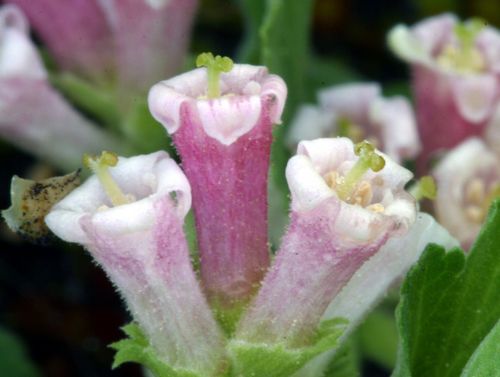
Ribes cereum is a species of currant known by the common names wax currant (R. c. var. pedicellare is known as whisky currant). It is native to western North America, including British Columbia, Alberta, and much of the western United States, from Washington, Oregon, and California east as far as the western Dakotas and the Oklahoma Panhandle. Ribes cereum grows in several types of habitat, including mountain forests in alpine climates, sagebrush, and woodlands. It can grow in many types of soils, including sandy soils and soil made of clay substrates, serpentine soils, and lava beds. This is a spreading or erect shrub growing 20 centimeters (8 inches) to 2 meters (80 inches) tall. It is aromatic, with a "spicy" scent. The stems are fuzzy and often very glandular, and lack spines and prickles. The leaves are somewhat rounded and divided into shallow lobes which are toothed along the edges. The leaves are hairless to quite hairy, and usually studded with visible resin glands, particularly around the edges. The inflorescence is a clustered raceme of 2 to 9 flowers. The small flower is tubular with the white to pink sepals curling open at the tips to form a corolla-like structure. Inside there are minute white or pinkish petals, five stamens, and a two protruding green styles. The fruit is a rather tasteless red berry up to a centimeter (0. 4 inch) wide, with a characteristically long, dried flower remnant at the end.
One of it's former common names (S**** currant) is considered derogatory as a slur used against Native women.
Shrub
8 - 36 in Tall
Rounded
Fast
Winter Deciduous

White, Pink, Red
Summer
Full Sun, Partial Shade
Moderate
Moderate
Fast, Medium, Slow
Prefers sandy or loamy soils. Does not grow well in clay soils.
For propagating by seed: 4-5 mos. stratification at 28° to 32°F ( USDA Forest Service 1974).
Dry slopes, rocky places, forest edges
Alpine Fell-Fields, Lodgepole Forest, Pinyon-Juniper Woodland, Red Fir Forest, Subalpine Forest, Yellow Pine Forest
Butterflies and moths supported
3 confirmed and 81 likely
Nuttall's Sheep Moth
Hemileuca nuttalli
Tailed Copper
Lycaena arota
Hoary Comma
Polygonia gracilis
Milbert's Tortoiseshell
Aglais milberti