

Carried by 1 nurseries
View Availability at NurseryData provided by the participants of the Consortium of California Herbaria
View additional distribution information on the Jepson eflora
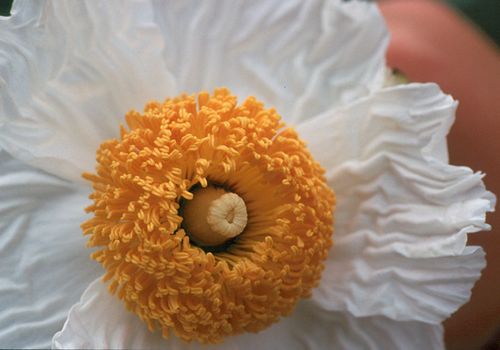
Romneya trichocalyx is species of flowering plant in the poppy family. This poppy is native to southern California and Baja California, where it grows in dry canyons in chaparral and coastal sage scrub plant communities, sometimes in areas recently burned.It is a popular ornamental plant, kept for its large, showy flowers. This is a shrub which may exceed two meters in height, its woody stem growing from a network of rhizomes. The gray-green, waxy-textured leaves are each divided into a few lance-shaped lobes, the blades growing up to 20 centimeters long. The inflorescence is a large, solitary flower with six crinkly white petals each up to 10 centimeters long. At the center of the flower is a cluster of many yellow stamens. The fruit is a bristly capsule 3 or 4 centimeters long containing many tiny seeds. This plant bears the largest flowers of any species native to California, rivaled only by Hibiscus lasiocarpos. It was nominated for the honor of California state flower in 1890, but the California poppy won the title in a landslide.
This plant is very similar to Romney coulteri in both appearance and requirements. This species differs only in having more prominent bristles on the sepals. Most plants sold in nurseries in California will be coulteri; trichocalyx is rarely available. The two species will hybridize and there is at least one named horticultural hybrid known as 'White Cloud'.
Perennial herb
4 - 7 ft Tall
20 ft Wide
Upright Columnar, Weeping
Moderate
Summer Deciduous
None

White, Yellow
Spring, Summer
Full Sun
Very Low
Never irrigate once established
Fast, Medium
Prefers sandy or gravelly soil with fast drainage.
Soil PH: 5.0 - 8.0
It is advisable to cut down to 6 inches in late summer of fall. Dried leaves and stalks make excellent mulch when chopped or broken up.
Usually by rhizomes during winter. Disturbing rhizomes at other times is usually fatal. Propagation by seeds is difficult.
4*, 5*, 6, 7, 8*, 9*, 10, 11, 12, 14*, 15*, 16*, 17*, 18*, 19*, 20*, 21*, 22*, 23*, 24*
Dry washes and canyons as part of chaparral or coastal sage scrub
Chaparral, Coastal Sage Scrub, Lowland Chaparral, Southern Coastal Scrub
Grows well with a variety of chaparral plants including Scrub Oaks, Manzanitas, Coyote Brush (Baccharis pilularis ssp. pilularis), Laurel Sumac (Malosma laurina), Chaparral Mallow (Malacothamnus fasciculatus), Toyon and Lemonade Berry
Butterflies and moths supported
0 confirmed and 1 likely