

Carried by 0 nurseries
View Availability at NurseryData provided by the participants of the Consortium of California Herbaria
View additional distribution information on the Jepson eflora
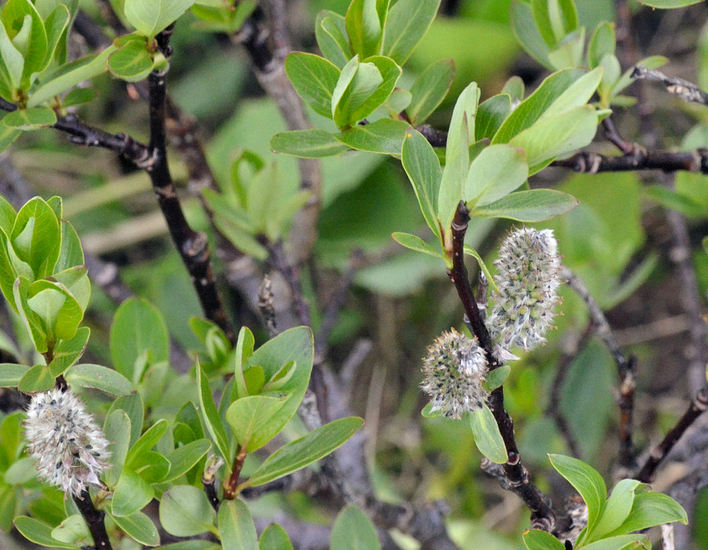
Salix planifolia is a species of willow known by the common names planeleaf willow, diamondleaf willow, and tea-leafed willow. It is native to northern and western North America, including most of Canada and the western United States. It grows in many types of arctic and alpine habitats in the north, and mountainous areas in the southern part of its range. Salix planifolia is a shrub varying in size from low and bushy, to long thickets, to a treelike form 9 m (30 ft) in height. The leaves are generally oval in shape with pointed tips, measuring up to 6. 5 cm long. They are smooth-edged or serrated, glossy on the upper surface, and sometimes with silky hairs. The inflorescence is a catkin of flowers a few centimeters long. Salix planifolia is a shrub varying in size from low and bushy, to long thickets, to a treelike form 9 m (30 ft) in height. The leaves are generally oval in shape with pointed tips, measuring up to 6. 5 cm long. They are smooth-edged or serrated, glossy on the upper surface, and sometimes with silky hairs. The inflorescence is a catkin of flowers a few centimeters long. Salix pulchra, also commonly called diamondleaf or tealeaf willow and sometimes treated as a subspecies of S. planifolia (S. planifolia ssp. pulchra), is now treated as a distinct species.
Tree
8 - 30 ft Tall
Upright
Fast
Winter Deciduous

Green, Cream, Yellow
Spring
Partial Shade
High
Prefers sandy or loamy soils. Does not grow well in clay soils.
For propagating by seed: No treatment. Use fresh seeds (usually only viable a few days). Seeds should not be covered or pressed into a medium. Seedbed should be kept saturated for the first month. Easily propogated from cuttings.
meadows, riverbanks
Alpine Fell-Fields, Lodgepole Forest, Subalpine Forest, Wetland-Riparian
Butterflies and moths supported
0 confirmed and 152 likely
Luteus Dart Moth
Abagrotis trigona
Frosty Dagger Moth
Acronicta brumosa
Fingered Dagger Moth
Acronicta dactylina