

Carried by 30 nurseries
View Availability at NurseryData provided by the participants of the Consortium of California Herbaria
View additional distribution information on the Jepson eflora
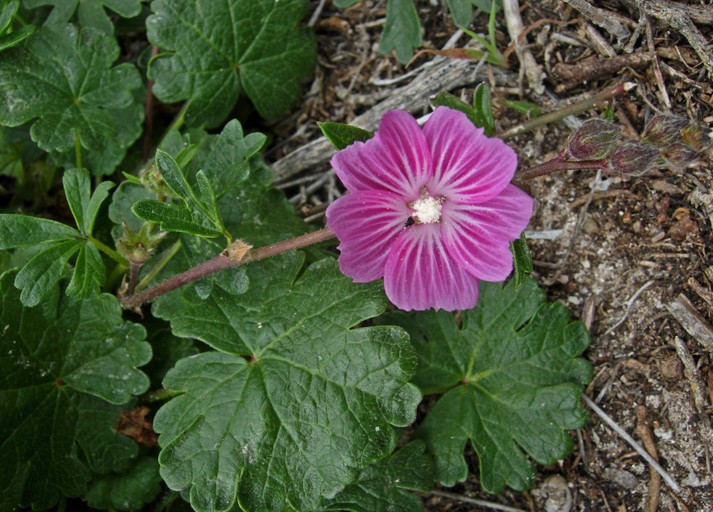
Checker Bloom (Sidalcea malviflora) is a common native perennial herb in the Malvaceae (Mallow) family that grows in Northern, Southern and Central California, the Sierra Nevada and Sacramento Valley regions. It tends to grow in meadows and open flats, at elevations from sea level to 7,500 feet. It has bright green palmate leaves and 1" deep pink flowers arranged vertically on a spike. There are several recognized subspecies with different geographic ranges and slightly differing characteristics.
This plant tolerates a wide variety of soils, and prefers damp winter conditions and dry summer conditions. It is most often started from seed and sometimes behaves like an annual.
Perennial herb
4 - 18 in Tall
3 - 6 in Wide
Spreading
Fast
Summer Semi-deciduous

Green, Pink
Summer, Spring
Deer resistant, Groundcover
Full Sun, Partial Shade
Low, Moderate
Max 1x / month once established
Tolerates cold to 0 - 10° F
Fast, Medium, Slow
Tolerates wide variety of soils.
Tolerates serpentine soil..
Soil PH: 6 - 7
By seed. For propagating by seed: Soak in warm water 6 hrs. ( Emery and Frey 1971).
4, 5, 6*, 7*, 8*, 9*, 14*, 15*, 16*, 17*, 18*, 19*, 20*, 21*, 22*, 23*, 24*
Found in a variety of settings and habitats including coastal prairie, coastal sage scrub, dry, open flats with grassland, meadows, and openings in chaparral, woodland or forest (oak, redwood, pine or fir), primarily along the coast and in the Coast Ranges, with scattered locations elsewhere.
Coastal Prairie, Foothill Woodland, Mixed Evergreen Forest, Forest, Valley Grassland, Yellow Pine Forest
Many companion plants depending on region. Because it is low growing, plant with other short plants so it won't be obscured, such as native bunch grasses, annuals and bulbs.
Butterflies and moths supported
4 confirmed and 2 likely
Common Checkered-Skipper
Pyrgus communis
Two-banded Checkered-Skipper
Pyrgus ruralis
West Coast Lady
Vanessa annabella