

Carried by 1 nurseries
View Availability at NurseryData provided by the participants of the Consortium of California Herbaria
View additional distribution information on the Jepson eflora
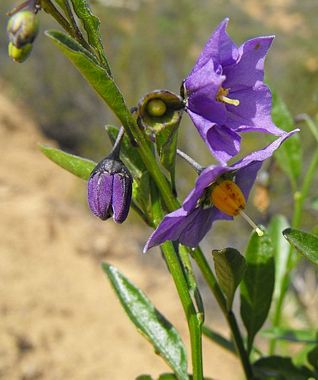
Parish's Nightshade (Solanum parishii) is a native shrub in the Solanaceae (Nightshade) family that grows in primarily in two disjunct regions, the mountains and valleys of northern California and the chaparral of southernmost California. It occurs from sea level up to elevations of 6,000 feet. A closely related species is Solanum xanti, and their ranges overlap in the southern counties. There are also several non-native species of Solanum that look very similar. Some are sold under the common name Potato Plant. The flowers of Solanum parishii are small but attractive. As with many other members of this family, the plant is poisonous to humans and some other animals, especially the fruits. Be cautious in using it where children or pets may have access. Due to the poisonous nature of many nightshades, tomatoes (also a member of the Solanaceae) were thought to be equally toxic by many North Americans as late as the early eighteenth century.
Shrub
3 ft Tall
1 - 5 ft Wide
Pleasant

Purple
Winter, Spring
Full Sun, Partial Shade
Very Low
Max 2x / month once established
Tolerates cold to 5° F
Fast, Medium, Slow
Tolerates a wide variety of soils including clay, sand, loam and decomposed granite.
1, 2, 3, 7, 14, 15, 16, 17, 18, 19, 20, 21, 22, 23, 24
In its northern range it is found in rugged, forested, mountainous areas. In its southern range it occurs as part of the xeric chaparral community from the immediate coast to the foothills and higher mountains.
Chaparral, Foothill Woodland, Yellow Pine Forest
In northern California: Use with woodland species such as Maple (Acer spp.), Serviceberry (Amelanchier spp.), Madrone (Arbutus menziesii), Manzanita (Arctostaphylos spp.), Pipevine (Aristolochia californica), Spice Bush (Calycanthus occidentalis), Bush Anemone (Carpenteria californica), Ceanothus spp., Mock Orange (Philadelphus lewisii), Pine (Pinus spp.), and Oak (Quercus spp.)
In southern California: Use with chaparral species such as Manzanita (Arctostaphylos spp. or Xylococcus spp.), Ceanothus spp., Dudleya spp., Brittlebush (Encelia californica), Toyon (Heteromeles arbutifolia), Sticky Monkeyflower (Diplacus aurantiacus), Scrub Oak (Quercus berberiidifolia or dumosa), Lemonade Berry (Rhus integrifolia), Sage (Salvia spp.), Yucca (Hesperoyucca spp. and Yucca spp.) and various cactus species
Butterflies and moths supported
0 confirmed and 33 likely
Ipsilon Dart
Agrotis ipsilon
Old Man Dart
Agrotis vetusta
Orange Tortrix Moth
Argyrotaenia franciscana
Alfalfa Looper Moth
Autographa californica