

Carried by 7 nurseries
View Availability at NurseryData provided by the participants of the Consortium of California Herbaria
View additional distribution information on the Jepson eflora
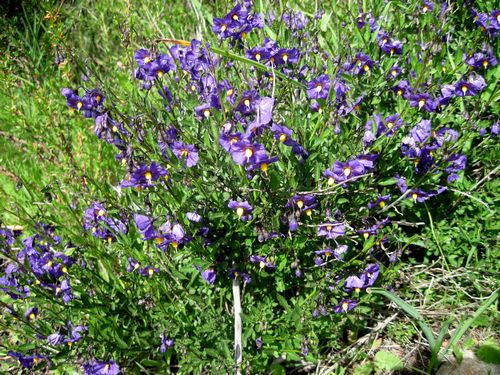
Bluewitch Nightshade (Solanum umbelliferum) is a native shrub Solanaceae (Nightshade) family that is widespread in California in various habitats and vegetation communities, at elevations from sea level to 5,200 feet. The stems are densely hairy and branched. The leaves are grey-green, elliptical to oval, and typically smooth edged. The flower is blue to purple in color, consisting of five petals fused together, with contrasting yellow anthers. The fruit is a sphere 12-14 mm in size. Its habit is mounding or sometimes vining, often found climbing up through more woody shrubs. All parts of the plant are toxic to people and some animals. However, it is very attractive to insects. If given occasional summer water it will stay leafed-out and may even continue to flower. If allowed to dry it will be summer deciduous. This is a very tough, hardy plant that will survive on neglect.
Shrub
2 - 3 ft Tall
2 - 3 ft Wide
Moderate
Evergreen, Summer Semi-deciduous

Blue, Lavender, Purple, Yellow
Spring, Summer, Winter
Deer resistant
Full Sun, Partial Shade
Very Low
Max 1x / month once established
Moderate
Tolerates cold to 0° F
Fast, Medium
Tolerates a variety of soils.
Tolerates saline soil.,Tolerates sodic soil..
Soil PH: 5.5 - 7.5
For propagating by seed: Stored seeds scarification or hot water for 1 hr. only ( Emery and Frey
7*, 8, 9, 10, 14*, 15, 16, 17, 19*, 20*, 21*, 22*, 23*, 24
Dry, rocky slopes, canyons and mesas throughout the state, in various plant communities including chaparral, sage scrub, grassland, and woodlands
Chaparral, Coastal Sage Scrub, Foothill Woodland, Mixed Evergreen Forest, Northern Coastal Scrub, Valley Grassland
Use with any Sage Scrub or Chaparral plants including Lemonadeberry (Rhus integrifolia), Manzanita (Arctostaphylos spp.), Mission Manzanita (Xylococcus bicolor), Toyon (Heteromeles arbutifolia), Ceanothus species, Milkweed (Asclepias spp.), Giant Wild Rye (Elymus condensatus), Sand Aster (Corethrogyne filaginifolia), Sagebrush (Artemisia californica), Monkeyflower (Mimulus spp.), Encelia californica, Buckwheat (Eriogonum spp.), Heartleaf Keckiella (Keckiella cordifolia), Penstemon species, Salvia species, Scrub Oak (Quercus berberidifolia or dumosa), and and Yucca (Hesperoyucca whipplei or Yucca schidigera)
Butterflies and moths supported
1 confirmed and 34 likely
Eggplant Leafroller
Lineodes integra
Ipsilon Dart
Agrotis ipsilon
Old Man Dart
Agrotis vetusta
Orange Tortrix Moth
Argyrotaenia franciscana