

Carried by 36 nurseries
View Availability at NurseryData provided by the participants of the Consortium of California Herbaria
View additional distribution information on the Jepson eflora
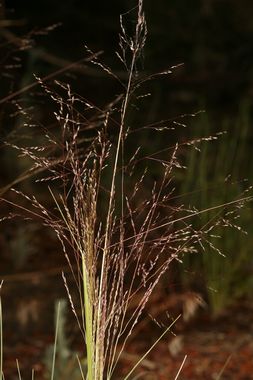
Alkali Sacaton (Sporobolus airoides) is a moderately fast-growing and moderately long-lived bunchgrass, native to southern and central California. It thrives in a variety of habitats, from coastal areas to foothills, central valley, and desert mountains, typically in locations with slightly more moisture. Its most notable feature is its ability to tolerate alkaline soils, which is reflected in its name. Early settlers viewed it as an indicator of underground water. This grass grows upright to a height of 3 feet, with active growth in spring and summer, producing yellow flowers that bloom in mid-summer. The showy seedheads persist throughout the summer and last for many months. The medium green leaves are deciduous and fall off in winter.
Alkali Sacaton is found in moist, but not saturated, places at elevations ranging from 0 to 6,900 feet. It can tolerate occasional foot traffic, but it should not be considered as a replacement for a lawn in areas that experience regular or heavy foot traffic.
Grass
3 - 4 ft Tall
2 ft Wide
Upright, Fountain
Moderate
Winter Deciduous
None

Yellow
Summer
Deer resistant, Groundcover, Lawn alternative
Full Sun
Very Low, Low
Max 2x / month once established
Easy
Tolerates cold to 5° F
Medium
Tolerates a variety of soils.
Tolerates sodic soil..
Soil PH: 7.0 - 9.0
Dormant plants may be cut back
For propagating by seed: Soak in 1% (2% okay) potassium nitrate for 24 hrs.; sowing wet gives slightly better results than air drying 1-3 days first. Germinate at high diurnal fluctuation, room temperature (70.5° to 78.8°) and 91.4°P (Anonymous 1944). No treatment. but using the high diurnal fluctuation (60.8° to 75.2°) and 95°P may also give good results [Toole 1941); for fresh seeds 2 wks. stratification first may improve germination (Toole 1941). No treatment. if sown outdoors in southern California during July or August may give good germination.
1, 2, 3, 7*, 8*, 9*, 10*, 11*, 12*, 13*, 14*, 15*, 16*, 17*, 18*, 19*, 20*, 21*, 22*, 23*, 24*
Found in generally arid landscapes where there is underground moisture, including alkaline sinks, playas, edges of vernal pools or seasonal drainages
Alkali Sink, Coastal Sage Scrub, Wetland-Riparian
Use with other moisture loving or alkali-tolerant plants such as Saltbush (Atriplex spp.), Apache Plume (Fallugia paradoxa), Rush (Juncus spp.), Evening Primrose (Oenothera elata), and Antelope Bitterbrush (Purshia tridentata)
Butterflies and moths supported
0 confirmed and 2 likely
Wandering Skipper
Panoquina errans
Sandhill Skipper
Polites sabuleti