

Carried by 10 nurseries
View Availability at NurseryData provided by the participants of the Consortium of California Herbaria
View additional distribution information on the Jepson eflora
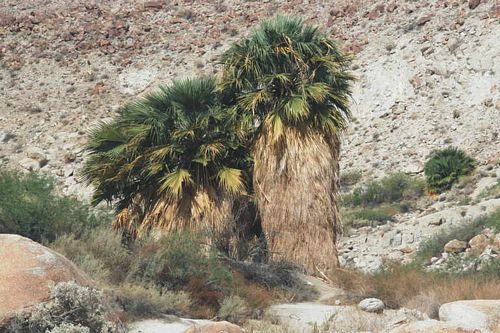
Fan palm (Washingtonia filifera) is a tree in the Palm family (Arecaceae). Commonly called desert fan palm or California fan palm, it is the only palm native to the western United States and is the country's largest native palm. It is an evergreen monocot with large sprays of creamy white flowers, up to 15 feet (5 meters) long, appear in summer, followed by abundant clusters of small, pea-sized black fruits.
Primarily found in Creosote Bush Scrub and Desert Riparian habitats such as rivers, seeps and springs, this palm is a keystone species in Desert Oases, and supports desert species of wildlife, such as the Western Yellow Bat, the Hooded Oriole and the Palm Flower Moth.
Although Fan Palm grows near springs, it is actually quite drought-adapted in gardens. Place in well-drained soil in full sun. It is not necessary to prune dead leaves; however, this can be done by cutting them off close to the trunk. Remove these carefully in order to protect any bats or birds that may get crushed by the heavy leaves.
Tree
49 - 66 ft Tall
10 - 15 ft Wide
Upright Columnar
Moderate
Evergreen

White, Yellow
Winter, Spring
Deer resistant
Full Sun
Low, Moderate
Max 1x / month once established
Easy
Tolerates cold to 14° F
Fast
Prefers well drained soils, suseptible to root rot in excessively wet soils.
Soil PH: 6.1 - 9.2
Periodically remove dead leaves, which form a skirt
For propagating by seed: No treatment.
8*, 9*, 10, 11*, 12*, 13*, 14*, 15*, 16*, 17, 18*, 19*, 20*, 21*, 22*, 23*, 24
Moist places
Creosote Bush Scrub, Wetland-Riparian
Use with other desert trees and shrubs such as Desert Agave (Agave deserti), Elephant Tree (Bursera microphylla), Desert Lavender (Condea emoryi), Brittlebush (Encelia farinosa or actonii), Barrel Cactus (Ferocactus cylindraceus), Ocotillo (Fouquieria splendens), Chuparosa (Justicia californica), Beavertail Cactus (Opuntia basilaris), Palo Verde (Parkinsonia spp.), Smoketree (Psorothamnus spinosus), Joshua Tree (Yucca brevifolia), and Mojave Yucca (Yucca shidigera).
Butterflies and moths supported
1 confirmed and 0 likely
Palm Flower Moth
Litoprosopus coachella