

Carried by 1 nurseries
View Availability at NurseryData provided by the participants of the Consortium of California Herbaria
View additional distribution information on the Jepson eflora
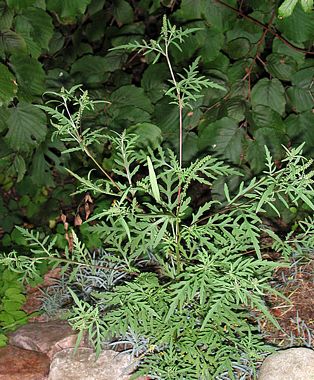
Ambrosia psilostachya is a species of ragweed known by the common names Cuman ragweed, perennial ragweed, and western ragweed. It is native to most of North America including all of southern Canada, nearly all of the continental United States, and the northern half of Mexico. It is a common plant in many habitat types, including disturbed areas such as roadsides. It can be found in parts of Eurasia as an introduced species. This is an erect perennial herb growing a slender, branching, straw-colored stem to a maximum height near two meters, but more often remaining under one meter tall. Leaves are up to 12 centimeters long and vary in shape from lance-shaped to nearly oval, and they are divided into many narrow, pointed lobes. The stem and leaves are hairy. The top of the stem is occupied by an flower cluster which is usually a spike. The species is monoecious, and the flower cluster is composed of staminate (male) flower heads with the pistillate heads located below and in the axils of leaves. The pistillate heads yield fruits which are achenes located within oval-shaped greenish-brown burs about half a centimeter long. The burs are hairy and sometimes spiny. The plant reproduces by seed and by sprouting up from a creeping rhizome-like root system. This plant had a number of medicinal uses among several different Native American groups.
Perennial herb
4 - 7 ft Tall
1 ft Wide
Spreading
Winter Semi-deciduous

Green
Summer, Fall
Groundcover
Full Sun
Low, Moderate, High
Max 1x / month once established
Tolerates cold to 15° F
Fast, Medium, Slow
Adaptable.
Soil PH: 5.2 - 8.2
Commonly occurs throughout California on roadsides, disturbed areas, and dry fields.
Weed (disturbed places), Wetland-Riparian
Ambrosia psilostachya can do well in a variety of conditions, so the soil type of your garden will best inform which other plants to choose. Consider using other natives that do well in sunny, sandy sites, such as Nuttall's scrub oak (Quercus dumosa), Desertbells (Phacelia campanularia), or the Bristly Matilija poppy (Romneya trichocalyx).
Butterflies and moths supported
2 confirmed and 20 likely
Garden Webworm Moth
Achyra rantalis
Ambrosia Plume Moth
Adaina ambrosiae