

Carried by 31 nurseries
View Availability at NurseryData provided by the participants of the Consortium of California Herbaria
View additional distribution information on the Jepson eflora
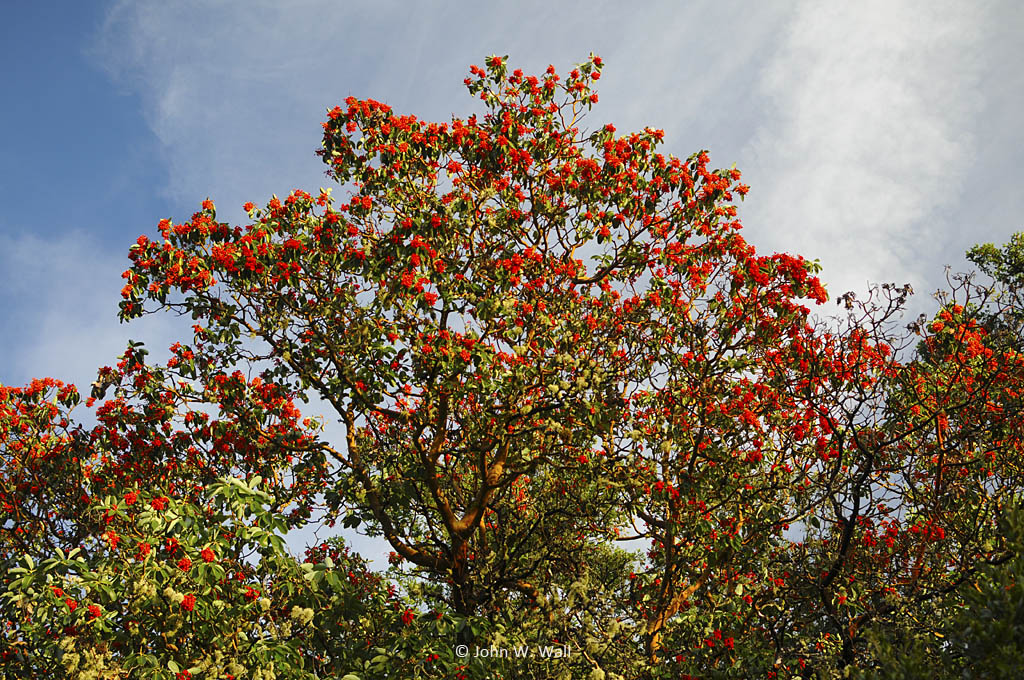
The Pacific Madrone (Arbutus menziesii) is also known as the Madroo, Madroa, Bearberry, or Strawberry Tree, or simply referred to as Arbutus. It is a broadleaf evergreen tree with rich orange-red bark that peels away on the mature wood, leaving a greenish, silvery appearance that has a satin sheen and smoothness. The exposed wood sometimes feels cool to the touch. In spring, it bears sprays of small bell-like flowers, and in autumn, red berries.
Plant in a shady or partially shaded location, and avoid direct summer water. It prefers north-facing slopes especially in drier locations. Madrone is a particularly beautiful plant, but it grows very slowly in the southern, drier part of its range, where it typically grows to only 25 feet. In the northern, moister part of its range, it can grow quickly to 100 feet.
It is found on the west coast of North America, from British Columbia to California - but also scattered on the west slope of the Sierra Nevada mountains. It becomes rare south of Santa Barbara County, with isolated stands south to Palomar Mountain, San Diego County and northern Baja California, Mexico.
It is common to see madrones of about 10-25 meters in height, but, in the right conditions, the trees reach up to 30 meter. In best conditions, a madrone can also reach a thickness of 5-8 feet at its trunk, much like an oak tree.
The leaves are thick, oval, 7-15 centimeter long and 4-8 centimeter broad, and arranged spirally; they are glossy dark green above and a lighter, more grayish green beneath, with an entire margin. The leaves brown during the fall season and detach from the branches.
Pacific madrone seeds are dispersed largely by birds but also by mule deer, rodents, and gravity; robins, starlings, band-tailed pigeons feast on the ripe berries and subsequently disperse the seeds as they move about.
Tree
15 - 100 ft Tall
5 - 25 ft Wide
Rounded, Upright Columnar
Slow
Evergreen
Slight

White, Red
Spring
Bank stabilization, Hedge
Partial Shade
Low
Max 1x / month once established
Moderate
Tolerates cold to 10° F
Fast, Medium
Heavy.
Tolerates serpentine soil..
Soil PH: 5 - 7
For propagating by seed: 2-3 mos. stratification.
3, 4, 5*, 6, 7, 9, 14, 15, 16, 17, 18, 23, 24
Shady forests with Redwood, Pine or Fir; also Foothill Woodland and Oak Woodland. Prefers north slopes and well-draining soil
Douglas-Fir Forest, Foothill Woodland, Mixed Evergreen Forest, Northern Oak Woodland, Forest, Southern Oak Woodland
Coast Live Oak (Quercus agrifolia var. agrifolia), Black Oak (Quercus kelloggii), California Bay Tree
Butterflies and moths supported
18 confirmed and 22 likely