

Carried by 7 nurseries
View Availability at NurseryData provided by the participants of the Consortium of California Herbaria
View additional distribution information on the Jepson eflora
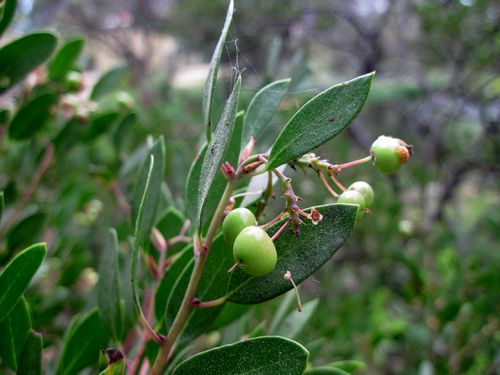
Vine hill manzanita (Arctostaphylos densiflora) is a very rare species of manzanita, endemic to Sonoma County, where it is known from only one extant population of 20 to 30 individuals. These last wild members of the species are on land near Sebastopol that is owned and protected by the California Native Plant Society. This is a small evergreen shrub that grows fast to about 3 feet or less, although cultivars may get taller. It is ideal for limited spaces.
Vine hill manzanita forms low, spreading clumps, as stems may root where they are in constant contact with soil. The foliage is a beautiful green, the bark smooth and red, and is a profuse bloomer with Clusters of pink flowers in winter stand out at the end of the stems and the foliage frames each cluster.
Vine hill manzanita tolerates almost any soil type. It prefers sun in coastal sites; sun or part shade in inland sites and takes low to very low water.
The flowers attract hummingbirds. Other birds are attracted to the fruit and seeds, and the local habitat is mostly chaparral on sandy shale soils. Vine hill manzanita is the origin of several popular cultivars including 'Sentinel' and 'Howard McMinn.'
Shrub
3 ft Tall
6 ft Wide
Mounding, Spreading
Moderate
Evergreen
Slight

Pink, White
Spring, Winter
Groundcover, Hedge
Full Sun
Very Low, Low
Max 2x / month once established
Easy
Tolerates cold to 10° F
Fast, Medium
Tolerates a variety of soils but performs best in a well-drained loam.
Soil PH: 5.0 - 8.0
Prune in late summer to achieve desired height or spread
Seed or by rooted cuttings
Chaparral on sandy shale outcrops and pine barrens near the coast primarily in Sonoma County
Chaparral, Closed-cone Pine Forest, Northern Coastal Scrub
Works well with a number of low- to medium-height plants including Ceanothus species, Buckwheat (Eriogonum spp.), and Sages (Salvia spp.).
Butterflies and moths supported
0 confirmed and 36 likely
Western Avocado Leafroller Moth
Amorbia cuneana
Miranda Underwing
Amphipyra pyramidoides