

Carried by 4 nurseries
View Availability at NurseryData provided by the participants of the Consortium of California Herbaria
View additional distribution information on the Jepson eflora
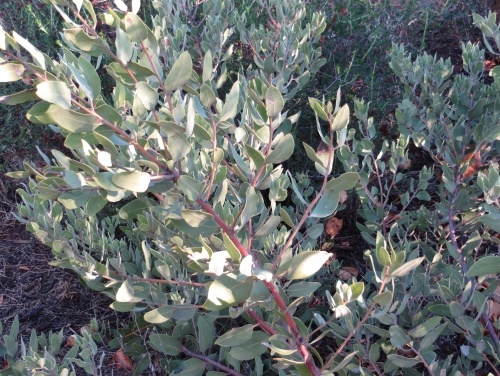
Del Mar or Costa Baja Manzanita (Arctostaphylos glandulosa ssp. crassifolia) is a rare native shrub that grows in Southern California, primarily in the South Coast region. Depending on the time of year, leaves can be pinkish, slivery, blue green or dark green. It tends to grow in rocky outcrops, slopes and ridges, at elevations from 0-700 feet. It can grow to 8 feet, but is usually under 4 feet with a loose mounding form.
Del Mar Manzanita is beautiful, relatively easy to grow and among the fastest growing of the manzanitas. It seems to do best if planted in the spring, when it can grow quickly and establish itself before the dry summer months. It handles weekly water for the first year after planting, after which it's best to naturalize. Plant on slopes or well draining flats. It will look green and vibrant year round if it can stretch its roots out to a nearby damper spot or irrigated area. It likes sun or part shade.
Shrub
6 - 96 in Tall
6 ft Wide
Mounding, Spreading
Moderate
Evergreen
Slight

Cream, Pink
Winter, Spring
Bank stabilization, Groundcover
Partial Shade, Full Sun
Low, Very Low
Max 2x / month once established
Tolerates cold to 10° F
Fast, Medium
This subspecies prefers eroded sandstone soils of marine deposits that are typical of coastal San Diego County.
Soil PH: 6 - 7.6
Accepts light pruning to shape or direct growth. This plant is subject to periodic branch die-back. This is usually not fatal to the plant. Dead branches may be removed or left in place. This is one of the burl forming Manzanitas that is able to regrow quickly after a fire.
Plant may spread by tip rooting
Rocky outcrops, slopes, ridges, or mesas where it is found in a rare vegetation community known as southern maritime chaparral, along with a number of other rare plants
Chaparral
Summer Holly (Comarostaphylis diversifolia ssp. diversifolia), Mission Manzanita Xylococcus bicolor), Scrub Oak (Quercus dumosa), California Encelia (Encelia californica), Chamise (Adeostoma fasciculatum), Coastal Pricklypear cactus (Opuntia littoralis), Mojave Yucca (Yucca shidigera), and Tree Poppy (Dendromecon rigida)
Butterflies and moths supported
0 confirmed and 29 likely
Western Avocado Leafroller Moth
Amorbia cuneana
Fruit-Tree Leafroller Moth
Archips argyrospila
Orange Tortrix Moth
Argyrotaenia franciscana