

Carried by 6 nurseries
View Availability at NurseryData provided by the participants of the Consortium of California Herbaria
View additional distribution information on the Jepson eflora
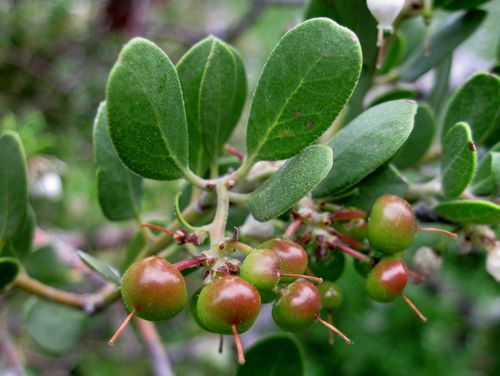
Arctostaphylos hookeri is a species of manzanita known by the common name Hooker's manzanita. This shrub is endemic to California where its native range extends from the coastal San Francisco Bay Area to the Central Coast. This is a low shrub which is variable in appearance and has several subspecies. These are generally mat-forming plants or low bushes with small green leaves, dense flower clusters of white to pink flowers, and shiny egg-shaped or round red drupes. It does not form a burl and can be killed by fire.
Hooker's Manzanita comes in a number of subspecies and cultivars. Two low growing, mounding forms include ssp. hearstiorum and Monterey Carpet (about 1 foot tall and 6 feet wide). Upright forms can reach 6 feet in height. In general, this species prefers full sun within a few miles of the coast, and part shade when more inland. This plant will tolerate some summer water (1-2x per month). It prefers dry, well drained, acidic soil and is slow growing. It is a great candidate for a rock garden or coastal bluff garden.
Shrub
1 - 6 ft Tall
6 ft Wide
Mounding, Spreading
Moderate
Evergreen
Slight

Pink, White, Red
Winter, Spring
Groundcover, Hedge
Full Sun, Partial Shade
Low
Max 2x / month once established
Tolerates cold to 0° F
Fast, Medium
Can tolerate a little clay but does best in heavy loam or sandy loam that is slightly acidic.
Soil PH: 5.0 - 6.0
Dry coastal slopes, bluffs and dunes, northern coastal scrub, and sandy openings in coastal pine woodlands from the bay area to San Luis Obispo County.
Closed-cone Pine Forest, Northern Coastal Scrub
Trees - Monterey Pine (Pinus radiata) or other pines and Coast Redwood (Sequoia sempervirens)
Low growing shrubs and herbs - Sagebrush (Artemisia spp.), Coyote Brush (Baccharis spp.), Ceanothus species, Dudleya species, Coast Buckwheat (Eriogonum latifolium), and Seaside Daisy (Erigeron spp.).
Butterflies and moths supported
0 confirmed and 45 likely
Western Avocado Leafroller Moth
Amorbia cuneana
Miranda Underwing
Amphipyra pyramidoides