

Carried by 14 nurseries
View Availability at NurseryData provided by the participants of the Consortium of California Herbaria
View additional distribution information on the Jepson eflora
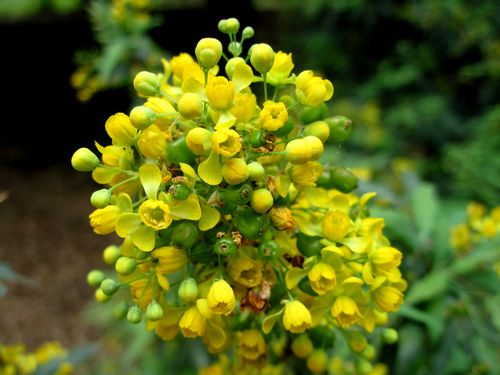
Nevin’s barberry (Berberis nevinii) is a striking evergreen flowering shrub. Nevin’s barberry with bright yellow flowers that is absolutely striking in full bloom in spring and also has attractive leaves and berries. The flowers are cup-shaped and appear in clusters against the dense, dark green to bluish-green leaves. The red to dark blue berries hang in bunches.
This is an erect shrub growing in full sun and soil that is well-drained. It is slow growing, usually to 5 feet tall and sometimes 13 feet. It is very cold hardy, heat tolerant, and can handle regular summer water. Because the leaves are quite spiny, it is best planted away from walkways and can serve as a barrier hedge.
It is deer-resistant and attracts birds and butterflies. Western Bluebirds are especially fond of the berries. It is a federally and state listed endangered species that is widely cultivated in gardens and parks.
Shrub
3 - 7 ft Tall
6 - 12 ft Wide
Mounding, Rounded
Slow
Evergreen
Pleasant

Yellow, Green
Spring
Hedge
Full Sun, Partial Shade
Very Low, Low, Moderate
Max 2x / month once established
Moderate
Tolerates cold to 15 - 30° F
Fast, Medium
Adaptable but prefers coarse well drained soil.
Soil PH: 6.0 - 8.0
Not necessary but can handle a hard pruning.
For propagating by seed: 2.5 -3 mos. stratification.
Sandy gravelly soils, washes, usually below 2000 ft. Nearest the coast it may be found in coastal sage scrub or chaparral. Inland in the Transverse Range or Peninsular Range it occurs in chaparral, desert transition or foothill woodland.
Chaparral, Coastal Sage Scrub
Chamise (Adenostema fasciculatum), Manzanita (Arctostaphylos spp.), Ceanothus species, Bush Poppy (Dendromecon rigida), Bladderpod (Peritoma arborea), Mountain Mahogany (Cercocarpus spp.), Sages (Salvia spp.)
Butterflies and moths supported
0 confirmed and 5 likely
Orange Tortrix Moth
Argyrotaenia franciscana
Barberry Geometer
Coryphista meadii
Fall Webworm
Hyphantria cunea