

Carried by 0 nurseries
View Availability at NurseryData provided by the participants of the Consortium of California Herbaria
View additional distribution information on the Jepson eflora
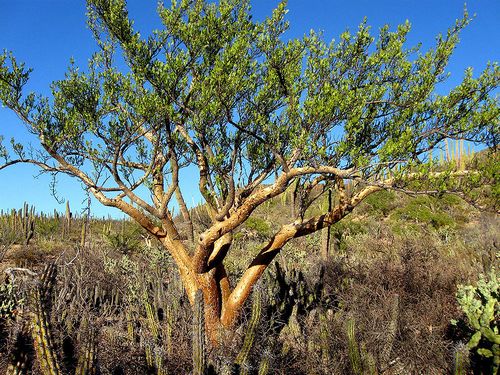
Elephant tree is a drought-adapted species in the Torchwood family, native to desert regions of the southwestern United States and northern Mexico. In the U.S., it is found in Southern California and Arizona, while in Mexico it grows in Baja California, Baja California Sur, Sonora, Sinaloa, and Zacatecas. The Anza-Borrego Desert in San Diego County marks the northern limit of its range in California. It is the only member of its family native to the U.S., though related species are more common in Mexico.
Although typically a small tree, the elephant tree can grow as a sprawling, shrub-like plant in harsher conditions, often reaching just three feet in height. It has light gray to white bark that peels off in thin, papery layers. Younger branches may appear reddish. The trunk is noticeably swollen, an adaptation that allows the tree to store water for long periods of drought. The leaves are small and light-colored, and the tree readily sheds them in response to dry conditions to conserve moisture.
Elephant tree produces rounded yellow buds that open into small, star-shaped flowers in white or cream hues. Its fruit is a yellow stone containing a single seed, which is dispersed by wildlife. The tree is well adapted to survive in extreme desert environments, thriving in rocky soils and withstanding prolonged dry spells.
The Cahuilla People of Southern California value the Elephant Tree for its red sap, which they used as a general remedy for various ailments. Its unique appearance, ecological role in desert habitats, and cultural significance make it an important plant in the arid landscapes it inhabits.
Tree, Succulent
13 ft Tall
10 ft Wide
Very Slow
Summer Deciduous
Pleasant

Yellow, Cream, White
Summer
Bank stabilization, Hedge
Full Sun
Very Low, Low
Max 2x / month once established
Moderate
Tolerates cold to 25° F
Fast
Typically decomposed granite.
For propagating by seed: No treatment.
Rocky slopes of the desert
Creosote Bush Scrub
It may be grown in a container almost indefinitely. If planted in the ground in a desert garden setting, it can be combined with many native desert shrubs, herbs and cacti from California and Baja. It is not usually offered for sale in native plant nurseries but may be found at specialty desert or succulent nurseries.
Butterflies and moths supported
1 confirmed and 1 likely
Ceanothus Silkmoth
Hyalophora euryalus