

Carried by 3 nurseries
View Availability at NurseryData provided by the participants of the Consortium of California Herbaria
View additional distribution information on the Jepson eflora
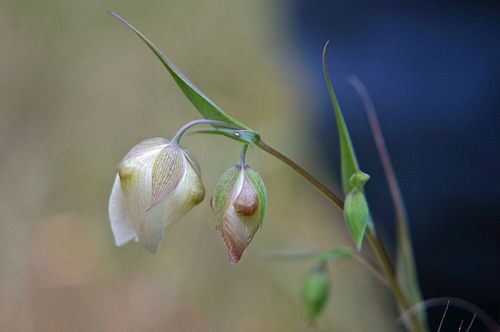
Calochortus albus is a species in the genus Calochortus in the family Liliaceae. It is also known by the common names fairy lantern, white fairy lantern, pink fairy lantern, lantern of the fairies, globe lily, white globe lily, white globe-tulip, alabaster tulip, Indian bells, satin bells, snowy lily-bell, and snow drops. Widespread, variable species, blooming in winter and spring and going dormant after anthesis (flowering period) until the start of the autumn rains. Height: 20-30-60-80 cm high at maturity. Stems: Stems are erect, to arching, slender, glaucous, and simple to branching, reaching 7. 5- 20- 70- 80 cm. Leaves: Leaves come in two types: cauline or basal (radical). One long basal leaf is present during blooming, along with several cauline leaves, and foliaceous bracts below the flowers. Basal/radical leaves: Basal leaves measure 20-30-50-70 cm in length, 1-5 cm in width, and are lax, shiny, and persistent. Cauline leaves: 2-6 laceolate to linear leaves, measuring 5-15-25 cm in length. Inflorescences: Flowers are borne in groups of 1- 2- many. Bracts are generally paired, lanceolate, and measure 1-5 cm in length. Flowers: Delicate, pendent, nodding, 2-3 cm closed orbs of pearly white, to pink, to deep pink, to almost wine-red, occasionally greenish. Flowers from late March- April-June- early July. Though the flowers of C. albus may occasionally be flushed pink, those which are deep rose in colour and are found from the southwest San Francisco Bay to outer south coast ranges may be assignable to C. albus var. rubellus, if recognized taxonomically. Perianth is oblong and is typically closed at the tip. Sepals: Three ovate to lanceolate sepals measuring 1-1. 5 cm long, appressed to the petals, rarely recurved. Sepals may be white, green, greenish-white, or rosy red, and are shorter than the petals. Petals: Three elliptic or wider petals, with the insides being sparsely ciliate (having a fringe of hairs), with yellowish, slender hairs above the nectary or along the gland. Satiny petals measure 2-2. 5 cm long, overlap slightly, are closed at the tip, and may have a green, copper, pink, lavender, or purple tinge on the outside of the flower, typically near the base of the petals and around the protruding glandular area. Nectary: Crescent-shaped, shallowly to deeply depressed, with several transverse, fringed membranes with white or yellow glandular hairs measuring 1/3-2/3 of the width of the petals. Stamens: Short, olbong, abruptly tipped, white to light pink stamens measuring 4 mm in length. Filaments: 4 - 5 mm in length, dilated at the base. Anthers: White to cream, oblong and obtuse, measuring 4 mm in length. Widespread in shady to open woods and scrub, partially shaded grasslands, exposed coastal bluffs, and is often found in rocky places. May be found in many plant communities below 5,000 ft or 2,000m, including foothill woodlands, yellow pine forests, and chaparral.
Perennial herb, Geophyte
8 - 31 in Tall
4 - 6 in Wide
Summer Deciduous

Pink, White
Spring, Winter
Containers
Full Sun, Partial Shade
Low, Very Low
Never irrigate once established
. Tolerates serpentine soil..
For propagating by seed: No treatment.
7*, 9, 14*, 15, 16, 17, 18, 19, 20, 21, 22, 23, 24
Under shrubs and mature trees in dry soils; Part shade Grasslands, Chaparral, Coastal Sage Scrub, Mixed-evergreen Forest and Yellow Pine Forest. Widespread in shady to open woods and scrub, partially shaded grasslands, exposed coastal bluffs, and is often found in rocky places. May be found in many plant communities below 5, 000 ft or 2, 000m, including foothill woodlands, yellow pine forests, and chaparral.
Chaparral, Foothill Woodland, Yellow Pine Forest
Butterflies and moths supported
0 confirmed and 1 likely
Orange Tortrix Moth
Argyrotaenia franciscana