

Carried by 3 nurseries
View Availability at NurseryData provided by the participants of the Consortium of California Herbaria
View additional distribution information on the Jepson eflora
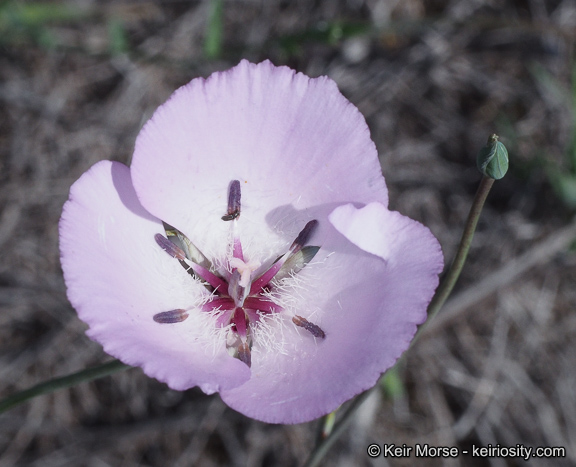
Calochortus splendens is a species Liliaceae (Lily) family known by the common name Splendid Mariposa Lily. It is native to California and Baja California where it is found primarily near the coast, in foothills and valleys and on the west slope of the mountains. Growing from a bulb, it is usually found coming up among dense, low shrubs, herbs or grasses. It is a thin-stemmed lily with few leaves and bearing flowers singly or in flower clusters of up to four. Each flower is ringed with smaller, ribbonlike, curling leaves. The bowl-shaped flowers are of varying shades of blue, pink, purple, or lavender, with a spot of darker purple at the base of each petal. The flower may have numerous white hairs in the center and bright purple pollen. In the wild it blooms profusely following fire and then may not bloom again for years. In the garden do not expect it to bloom every year as flowering requires considerable expenditure of stored energy from the bulb.
Perennial herb, Geophyte
2 ft Tall
6 in Wide
Summer Deciduous

Pink, Purple, Lavender, Blue
Spring
Full Sun, Partial Shade
Low, Very Low
Never irrigate once established
Moderate
Tolerates cold to 10° F
Fast, Medium, Slow
Found in sandy or clay soils near the coast, or gravelly soils inland.
Best to buy bulbs, the larger the better. For propagating by seed: No treatment. Plants require 3-5 years from seed to produce flowers.
1, 2, 3, 7*, 9, 14, 15, 16, 17, 18, 19, 20, 21, 22, 23, 24
Seasonally dry slopes, flats and canyons
Chaparral, Foothill Woodland, Yellow Pine Forest
In the garden it works well with other geophytes such as Wild Onions (Allium spp.), Golden Star (Bloomeria spp.), Blue Dicks (Dichelostemma spp.), Brodiaea spp., Lilies (Lilium spp.), and Triteleia spp. Also works with native grasses and herbs, but avoid larger shrubs or the Calochortus may get lost in the understory.
Butterflies and moths supported
0 confirmed and 1 likely
Orange Tortrix Moth
Argyrotaenia franciscana