

Carried by 3 nurseries
View Availability at NurseryData provided by the participants of the Consortium of California Herbaria
View additional distribution information on the Jepson eflora
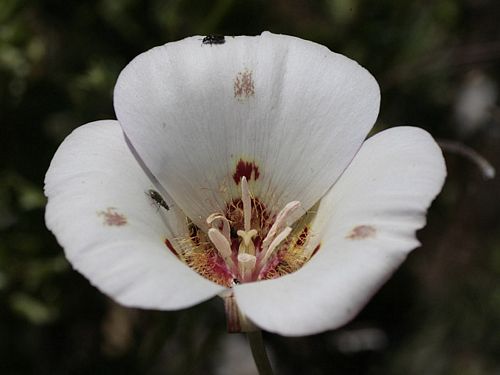
Calochortus venustus is a species of flowering plant in the lily family known by the common name butterfly mariposa lily. It is endemic to California, where it can be found in the sandy soils of a number of habitats in the mountains and foothills in the central part of the state. It is a perennial herb producing a branching stem 10 to 60 centimeters tall. There is a basal leaf up to 20 centimeters long which withers by the time the plant blooms. The flower cluster is a loose cluster of 1 to 6 erect, bell-shaped flowers. The flowers are variable in size and color pattern, though white is the most common color. They are often showy and intricately patterned. They generally have three curving sepals 2 or 3 centimeters long and three oval-shaped, clawed petals up to 5 centimeters long. The petals may be a variety of colors from white to pale pink or purple to bright red or orange, and sport a large dark central blotch and a smaller, paler blotch above. The fruit is an angled capsule 5 or 6 centimeters long. Although they tend to grow singly in the wild, they have more visual impact when massed in the garden. This plant needs summer dormancy, so withhold water after it has finished blooming.
Perennial herb, Geophyte
4 - 24 in Tall
6 in Wide
Upright Columnar
Summer Deciduous

Cream, Lavender, Orange, Pink, Purple, Red, White
Spring
Full Sun, Partial Shade
Low, Very Low
Never irrigate once established
Tolerates cold to -10° F
Fast, Medium, Slow
Tolerates clay but prefers fast draining soil.
Soil PH: 5.0 - 8.0
Seed propagation is very slow. Best results come from buying bulbs. For propagating by seed: No treatment.
1, 2, 3, 7*, 9, 14*, 15*, 16*, 17*, 18*, 19, 20, 21, 22, 23, 24
Sandy (often granitic) soil in grassy places, typically hilly areas of the Coast Ranges and Sierra foothills
Foothill Woodland, Valley Grassland, Yellow Pine Forest
Grassland species such as other Calochortus species, Allium species, Milkweeds (Asclepias spp.), Brodiaea species, Amole (Chlorogalum spp.), Dichelostemma species, Firtillaria species, various native grasses and various annual wildflowers
Butterflies and moths supported
0 confirmed and 1 likely
Orange Tortrix Moth
Argyrotaenia franciscana