

Carried by 7 nurseries
View Availability at NurseryData provided by the participants of the Consortium of California Herbaria
View additional distribution information on the Jepson eflora
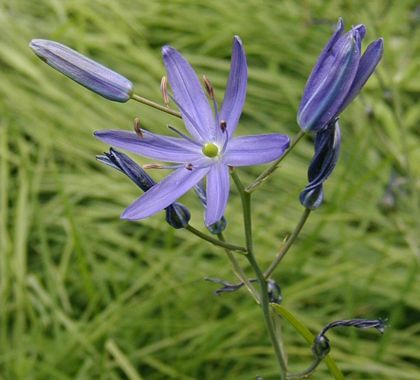
Camassia quamash, commonly known as camas, small camas, common camas, common camash or quamash, is a perennial herb. It is one species of the genus Camassia and is native to western North America in large areas of southern Canada and the northwestern United States, from British Columbia and Alberta to California and east from Washington state to Montana and Wyoming. Though the once-immense spreads of camas lands have diminished because of modern developments and agriculture, numerous camas prairies and marshes may still be seen today. In the Great Basin, expanded settlement by whites accompanied by turning cattle and hogs onto camas prairies greatly diminished food available to native tribes and increased tension between Native Americans and settlers and travelers. Both the Bannock and Nez Perce Wars began after Nez Perce became incensed at the failure of the US government to uphold treaties, and at settlers who plowed up their camas prairies, which they depended on for subsistence. Growth pattern. It is a perennial herbaceous monocot with leaves emerging from a persistent bulb in a basal rosette. Leaves, stems, and roots. The stems have a length between 30 and 90 centimetres (12 and 35 in). The leaves are basal and have a grass-like appearance. Inflorescence and fruit. The pale blue to deep blue flowers appear in late spring to early summer (May to June in their native habitat). They are arranged in a raceme at the end of the stem. Each of the radially symmetrical, star-shaped flowers has six petals. Taxonomy.
Perennial herb, Geophyte
1 - 2 ft Tall
Upright
Moderate

Blue, Purple, Pink, Lavender
Spring
Full Sun, Partial Shade
Moderate
Fast, Medium, Slow
Tolerant of a variety of garden soils as long as sufficient moisture is available.
For propagating by seed: Sow seeds, enclose seed container in polyethylene bag and refrigerate at less than 41°F. Remove from refrigerator and plastic bag when germination starts or in 3 mos.
meadows, streamsides
Mixed Evergreen Forest, North Coastal Coniferous Forest, Red Fir Forest, Yellow Pine Forest, Wetland-Riparian