

Carried by 2 nurseries
View Availability at NurseryData provided by the participants of the Consortium of California Herbaria
View additional distribution information on the Jepson eflora
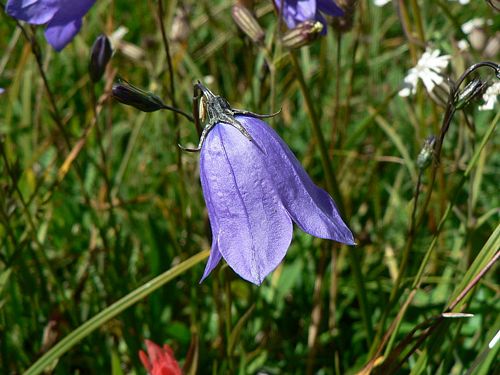
The Harebell (Campanula rotundifolia) is a short to medium, slender, hairless, rhizomatous perennial in the bellflower family Campanulaceae. In Scotland, it is often known as the Bluebell, whereas elsewhere in Britain, "bluebell" refers to Hyacinthoides non-scripta. The species is very variable in form. It occurs as tetraploid or hexaploid populations in Britain and Ireland, but diploids occur widely in continental Europe. The root leaves are dark green, roundish, usually slightly toothed, with prominent hydathodes and may wither early or persist all season. The leaves on the flowering stems become progressively more linear and the upper ones are unstalked. The flowers usually have fivefold symmetry, although other variants are quite frequent. The flowers are usually pale blue, although white, pink and violet variants occur, 15 millimeter long, borne on long thin stalks either singly or in loose clusters. The petal lobes are short and curve outwards. The flowers are pollinated by bees (see illustration) but can self-pollinate. In common with other Campanulas, all parts of the plant exude white latex when injured or broken. The seeds are produced in a capsule about 3-4 millimeter diameter. The seeds are released by decay of the capsule wall.
Perennial herb

Purple
Summer, Fall
Full Sun
Low, Moderate, High
Sandy, gravely soil.
For propagating by seed: No treatment. Seeds may need light for good germination ( Plants of the Southwest 1984).
1, 2, 4*, 5*, 6*, 7*, 14*, 15*, 16*, 17*, 19, 20, 21
Moist slopes
Lodgepole Forest, Red Fir Forest, Yellow Pine Forest, Wetland-Riparian