

Carried by 1 nurseries
View Availability at NurseryData provided by the participants of the Consortium of California Herbaria
View additional distribution information on the Jepson eflora
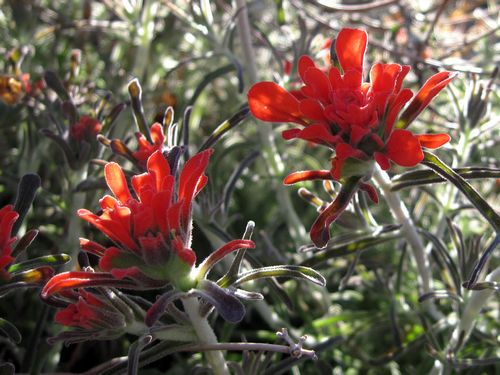
Castilleja foliolosa is a species of Indian paintbrush known by the common names woolly Indian paintbrush and Texas Indian paintbrush. It is native to California and northern Baja California, where it grows in coastal sage scrub, chaparral and rocky desert and mountain slopes. Despite its common name, it does not occur in Texas. It is a parasitic or semi-parasitic plant on a variety of small shrubs such as Chamise, Golden Yarrow or Sagebrush. This perennial wildflower grows up to 60 centimeters tall and is coated in woolly white or gray branching hairs. The leaves are linear in shape and up to 5 centimeters long. The flower cluster is made up of layers of leaves tipped in bright orange-red to dull yellowish green. Between the colorful leaves appear the nondescript flowers, which are greenish in color and pouch-shaped. The fruit is a capsule just over a centimeter long.
Annual herb, Perennial herb
2 ft Tall
2 ft Wide
Summer Deciduous

Red, Orange, Yellow, Green, White
Spring, Winter
Full Sun
Extremely Low, Very Low
Max 1x / month once established
Tolerates cold to 15° F
Fast
.
Soil PH: 6.0 - 8.0
None
Propagate by sowing seeds along with the seed of a host plant (chaparral shrub). For propagating by seed: No treatment. Sow with seeds of an herbaceous perennial as some Castilleja species are obligate parasites. Bouteloua gracilis has been recommended as host.
7, 14, 15, 16, 17, 22, 23, 24
Dry, open places, rocky slopes of the coast, Coast Ranges and foothills of the Sierras
Chaparral, Coastal Sage Scrub, Foothill Woodland, Northern Coastal Scrub, Southern Coastal Scrub, Valley Grassland, Yellow Pine Forest
It is found with most chaparral plants to which it attaches itself by the roots in a parasitic or semi-parasitic manner.
Butterflies and moths supported
1 confirmed and 14 likely
Leanira Checkerspot
Chlosyne leanira
Geranium Plume Moth
Amblyptilia pica
Orange Tortrix Moth
Argyrotaenia franciscana