

Carried by 18 nurseries
View Availability at NurseryData provided by the participants of the Consortium of California Herbaria
View additional distribution information on the Jepson eflora
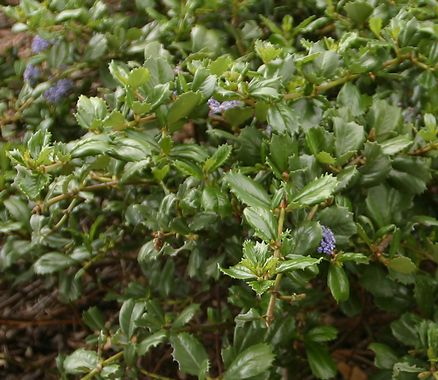
Point Reyes ceanothus is a low-growing, evergreen shrub that serves as a beautiful groundcover year-round. It features shiny, leathery green leaves and profuse bright blue flowers that emit a delightful fragrance. Endemic to California, this hardy plant thrives along the coastline of the San Francisco Bay Area and in coastal regions both north and south. It is commonly found on seaside bluffs and slopes of coastal mountains, where it endures harsh winds and salty air.
Beloved by birds and bees, Point Reyes ceanothus is an excellent choice for wildlife-friendly landscaping. The plant quickly forms a dense mat, with its stems rooting wherever they touch the ground, making it highly effective at controlling erosion on steep slopes. For gardeners, this ceanothus is a low-maintenance option, requiring little care beyond an occasional shearing after its bloom period to maintain height and shape. Its drought tolerance and soil-stabilizing properties make it ideal for coastal and hillside gardens.
Shrub
3 - 7 ft Tall
3 - 7 ft Wide
Mounding, Rounded, Spreading
Moderate
Evergreen
Pleasant

Blue, Purple, Pink, Lavender
Spring, Winter
Bank stabilization, Groundcover, Hedge
Partial Shade
Very Low
Max 3x / month once established
Easy
Tolerates cold to 0° F
Fast
Prefers beach sand.
Soil PH: 5.0 - 7.0
Prune to shape in late summer to early fall to minimize infection of the wound.
Seeds or cuttings. For propagating by seed: Hot water; then 3 montha stratification may improve germination.
Sandy places, bluffs, shrubby slopes, ridges, usually very near the coast and at low elevations in Marin and Mendocino Counties. Usually with Coastal Strand or Chaparral vegetation, or with Pine Forest, or Northern Coastal Scrub
Chaparral, Closed-cone Pine Forest, Coastal Strand, Douglas-Fir Forest, Northern Coastal Scrub
Manzanita (Arctostaphylos spp.), North Coast Dudleya (Dudleya farinosa), Seaside Daisy (Erigeron spp.), Seaside Buckwheat (Eriogonum latifolium), Coffeeberry (Frangula californica), Coast Silktassel (Garry elliptica), Lupine (Lupinus spp.)
Butterflies and moths supported
0 confirmed and 77 likely
Sallow Button
Acleris hastiana
Cottonwood Dagger Moth
Acronicta lepusculina