

Carried by 7 nurseries
View Availability at NurseryData provided by the participants of the Consortium of California Herbaria
View additional distribution information on the Jepson eflora
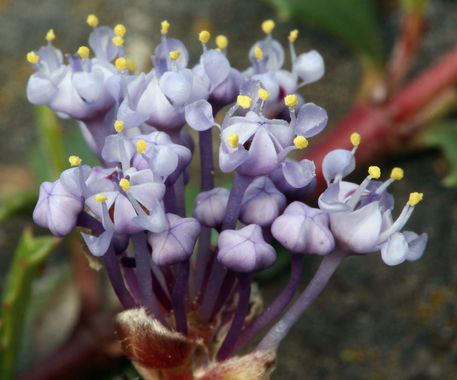
Ceanothus prostratus is a species of shrub in the Buckthorn family (Rhamnaceae) known by the common names prostrate ceanothus and mahala mat. It is native to the Pacific Northwest of the United States, into northern California and Nevada, where it grows in coniferous forest and open plateau. This is a flat, mat-forming shrub growing 6 inches tall up to about 8 ft. wide. The evergreen leaves are oppositely arranged, oval in shape with several large, sharp teeth along the edges. The upper surface is green and hairless, and the underside is paler in color and feltlike in texture. The flower cluster is a small cluster of deep blue or purple flowers. The fruit is a wrinkled capsule one half to one centimeter long.
Ceanothus prostratus grows in the understory of mixed conifer forests, from foothills to subalpine areas. It also inhabits open flats and ridges in areas of low chaparral as well as dry interior forest ecosystems. It can be found from elevations ranging between 1,000 and 9,000 ft. It is notoriously difficult to grow due to unknown factors.
Shrub
4 - 7 in Tall
3 - 6 ft Wide
Spreading, Mounding
Fast, Slow
Evergreen
Slight

Purple, Blue, Green
Spring, Winter
Groundcover, Bank stabilization, Deer resistant
Partial Shade, Full Sun
Very Low
Max 1x / month once established
Moderate
Tolerates cold to -20 - -10° F
Soil requirements are unclear.
Soil PH: 5 - 7
For propagating by seed: Hot water and 3.5 mos. stratification (2.5 mos. may be sufficient ). Boiling in water 1/2 minute, cooling immediately, then 156 days stratification may give better germination (USDA Forest Service 1974); or 30 mins. in concentrated H2 S04 then 2 mos. stratification (Heit 1971).
1, 2, 3, 4, 5, 6, 14, 15, 16, 18
Open flats,
Chaparral, Closed-Cone Coniferous Forest, Coastal Closed-Cone Coniferous Forest, Red Fir Forest, Yellow Pine Forest
Usually found in the wild with various evergreen, coniferous trees
Butterflies and moths supported
0 confirmed and 77 likely
Sallow Button
Acleris hastiana
Cottonwood Dagger Moth
Acronicta lepusculina