

Carried by 0 nurseries
View Availability at NurseryData provided by the participants of the Consortium of California Herbaria
View additional distribution information on the Jepson eflora
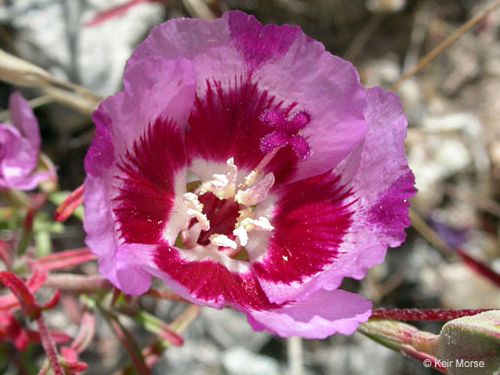
Clarkia speciosa is a species of flowering plant in the Onagraceae (Evening Primrose) family known by the common name Red Spotted Clarkia. It is endemic to California, where it is known from the Central Coast and mountains and from the Sierra Nevada foothills. The plant is variable across its intergrading subspecies, taking a decumbent to erect form with a stem up to about half a meter long. The open or dense flower cluster has opening flowers and several closed buds. As the bud opens the sepals all separate from each other. The fan-shaped petals are up to 2.5 centimeters long and may be lavender to pink to deep red, sometimes fading to white or yellowish at the base. There is sometimes, but not always, a large bright red spot near the middle of the petal. There are four subspecies of this plant. One, ssp. immaculata (also sometimes called var. immaculata), is known as the Pismo clarkia and is federally listed as an endangered species. It is known from about 20 occurrences on the coastline of San Luis Obispo County near Pismo Beach. This subspecies takes a decumbent form and the petals lack the red spot.
Annual herb
2 ft Tall
1 ft Wide

Pink, Red, Lavender
Spring, Summer
Full Sun, Partial Shade
Very Low
Fast, Medium, Slow
Adaptable.
sandy hills and canyons with chaparral or woodlands up to 6, 000 ft. elevation
Chaparral, Foothill Woodland
Use with other annuals or herbaceous perennials such as Snapdragon (Antirrhinum spp.), Sitka Columbine (Aquilegia formosa), Milkweed (Asclepias spp.), Chinese Houses (Collinsia heterophylla), Western Wallflower (Erysimum capitatum), Poppy (Eschscholzia spp.), Blue Field Gilia (Gilia capitata); with geophytes such as onion (Allium spp.), Mariposa Lily (Calochortus spp.); and with small succulents such as Dudleya spp.
Butterflies and moths supported
0 confirmed and 5 likely
Mariposa Forester
Alypia mariposa
White-lined Sphinx
Hyles lineata
Clark's Day Sphinx Moth
Proserpinus clarkiae