

Carried by 1 nurseries
View Availability at NurseryData provided by the participants of the Consortium of California Herbaria
View additional distribution information on the Jepson eflora
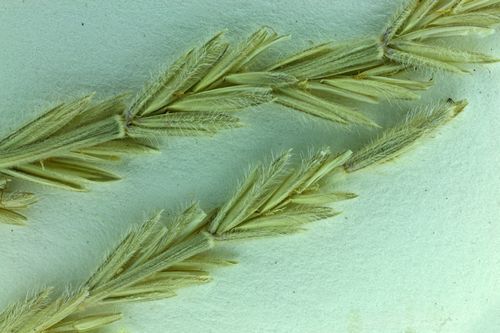
Elymus lanceolatus is a species of grass known by the common names thickspike wheatgrass and streamside wheatgrass. It is native to North America, where it is widespread and abundant in much of Canada and the western and central United States. There are two subspecies, ssp. lanceolatus occurring throughout the species' range and ssp. psammophilus occurring in the Great Lakes region. Elymus lanceolatus is a perennial, low growing, rhizomatous grass that actively grows in summer and spring. This plant is native to semiarid regions of the United States. Elymus lanceolatus is polymorphic, capable of growing in high altitude regions of the Rocky Mountains or at sea level near the Great Lakes in the United States. The bloom period for E. lanceolatus is mid-spring, and it is available commercially. Elymus lanceolatus is characterized by its yellow flowers, green or grey leaves, and brown seeds. According to the United States Department of Agriculture (USDA), it has a moderate harvest regrowth rate. Wheatgrass is unique in that in can adapt to fine, medium, and coarsely textured soils in the environment. However, it is shade intolerant, has a medium fertility requirement, and has a medium salinity tolerance. Studies suggest that amounts of soil needed for wheatgrass harvest can be approximated by understanding the plant' water depletion rate and rainfall amount in the region, which consequently helps reduce drainage. This grass produces hollow, erect stems up to 1. 3 metres (4. 3 feet) tall. The grass grows from a dense network of roots and rhizomes thickly intertwined to form a sod. The leaves are up to 25 centimetres (9. 8 inches) long and . 5 cm (0. 20 in) wide and are flat or slightly rolled at the edges. In dry, hot weather the leaves roll completely into cylindrical shapes. The inflorescence is a narrow, compact spike at the top of the stem, measuring up to 22 cm (8. 7 in) long. Each spikelet may have 2 to 11 flowers. The plant reproduces often by seed but in some areas, particularly in sandy substrates, it reproduces vegetatively by sprouting from its rhizome. New plants sprout from a soil seed bank, the seeds surviving in the soil for 3 to 4 years on average. The plant thrives under irrigation or in areas with 200-500 millimeters (8-20 inches) of annual precipitation.
Grass
2 - 4 ft Tall

Yellow, Green
Full Sun, Partial Shade
For propagating by seed: No treatment.
Open places
Foothill Woodland, Yellow Pine Forest
Butterflies and moths supported
0 confirmed and 8 likely