

Carried by 15 nurseries
View Availability at NurseryData provided by the participants of the Consortium of California Herbaria
View additional distribution information on the Jepson eflora
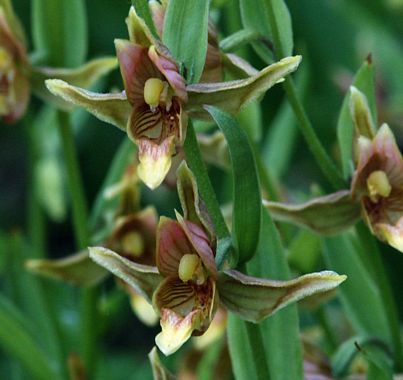
Epipactis gigantea is a species of orchid known by the common names stream orchid and giant helleborine. This wildflower is native to western North America from western Canada to central Mexico. This is one of the most abundant orchids of the Pacific coast of North America.
Epipactis gigantea is an erect perennial reaching anywhere from 30 centimeters to one meter in height. Its stems have wide or narrow lance-shaped leaves 5 to 15 centimeters long and inflorescences of two or three showy orchids near the top. Each flower has three straight sepals which are light brownish or greenish with darker veining, each one to two centimeters long. The two top petals are similar in shape and reddish-brown with purple veins. The lowest petal is cup-shaped with a pointed, tongue-like protuberance and is brighter red-brown and more starkly veined, often with areas of yellow. The fruit is a hanging capsule 2 or 3 centimeters long which contains thousands of tiny seeds. This plant grows in wet areas in a variety of habitats, including riverbanks, hot springs, and meadows. Unlike some of its relatives, this species is an autotroph. A distinctive race with burgundy colored foliage is known from The Cedars in Sonoma County California, an area of serpentine rock, and it is called forma rubrifolia (P M Brown).
Epipactis gigantea is cultivated in the specialty horticulture trade and available as a non-wild collected propagated ornamental plant for: natural landscape, traditional, native plant, and habitat gardens. A maroon leaved (forma rubrifolia) cultivar is also grown, called 'Serpentine Night'.
Perennial herb
1 - 2 ft Tall
6 in Wide
Upright Columnar
Moderate
Summer Deciduous
None

Orange, Red, Yellow, Green, Purple, Brown
Spring, Summer
Containers, Deer resistant, Water features or wet habitats
Partial Shade, Full Sun
High, Moderate
Keep moist
Tolerates cold to -10° F
Fast, Medium, Slow
Tolerant of sand and clay.
Soil PH: 5.0 - 8.0
Requires mycorrhizal fungi to germinate.
1, 2, 3, 4*, 5*, 6*, 7*, 8, 9, 10, 14*, 15*, 16*, 17*, 18, 19, 20, 21, 22*, 23*, 24*
Almost always found in wetland-riparian areas including seeps, wet meadows, and streambanks, adjacent to a variety of other vegetation types, including chaparral, grassland, and several types of woodland or forest.
Chaparral, Foothill Woodland
Leopard Lily (Lilium pardalinum ssp. pardalinum), Seep Monkeyflower, Scarlet Monkeyflower (Erythranthe cardinalis), Hedge Nettle, various Rushes and Sedges