

Carried by 51 nurseries
View Availability at NurseryData provided by the participants of the Consortium of California Herbaria
View additional distribution information on the Jepson eflora
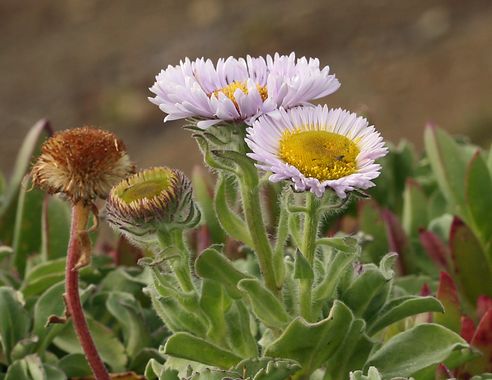
As its common name implies, Seaside Daisy (Erigeron glaucus) is a perennial plant in the Daisy family that grows on the coastline of California and also north into coastal Oregon. This cheerful plant has a long flowering season, which can be prolonged by deadheading spent flowers. It blooms profusely in shades of lavender and pink, with large yellow centers. The flowers are attractive to butterflies and bees.
Seaside Daisy is a sturdy, low-growing plant. It has very low water needs, especially when planted in coastal areas, where no irrigation is needed once it is established. When planted inland or in containers, some supplemental water is beneficial. Plant in sunny areas as a groundcover or part of a pollinator garden where it has room to spread.
Several cultivars are available. Wayne Roderick introduced two of the most common: Erigeron 'Wayne Roderick' and Erigeron 'W.R.' The 'Wayne Roderick' cultivar has dark purple flowers,and 'W.R.' is more heat tolerant, making it a good choice for inland gardens.
Perennial herb
2 - 12 in Tall
1 - 2 ft Wide
Mounding, Spreading
Fast
Evergreen
None, Slight

Lavender, Yellow
Winter, Spring, Summer
Containers, Deer resistant, Groundcover, Lawn alternative
Full Sun, Partial Shade
Low, Moderate
Max 1x / month once established
Easy
Tolerates cold to 15 - 20° F
Fast, Medium, Slow
Clay soils on steep slopes, sandy soils on flats.
Soil PH: 5 - 7
Cut back every 2-3 years in fall.
For propagating by seed: No treatment. Can be divided in fall or early spring when crown starts to separate.
5*, 9, 14*, 15*, 16*, 17, 18, 19, 20, 21, 22, 23, 24
Bluffs, dunes and beaches, ocean-facing ravines above the beach, clay soils, as part of Coastal Strand, Coastal Bluffs, or Coastal Sage Scrub.
Coastal Sage Scrub, Coastal Strand, Northern Coastal Scrub
Coast Dudleya (Dudleya caespitosa), Bright Green Dudleya (Dudleya virens ssp. virens), Lanceleaf Dudleya, California Sea Pink (Armeria maritima ssp. californica)
Butterflies and moths supported
2 confirmed and 9 likely
Orange Tortrix Moth
Argyrotaenia franciscana
Gabb's Checkerspot
Chlosyne gabbii
Northern Checkerspot
Chlosyne palla
Schmidt, M.G, Greenberg, K.L. (2012). Growing California Native Plants (2nd ed.). University of California Press