

Carried by 3 nurseries
View Availability at NurseryData provided by the participants of the Consortium of California Herbaria
View additional distribution information on the Jepson eflora
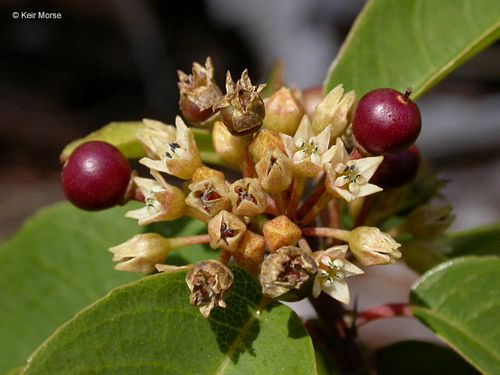
Western California Coffeeberry (Frangula californica subsp. occidentalis) grows in northern California and southwest Oregon, on serpentine soils. Fruit with three seeds; twigs brown; leaves with inconspicuous veins. In favorable conditions the plant can develop into a small tree over 6 meters tall. More commonly it is a shrub between 1 and 2 meters tall. The branches may have a reddish tinge and the new twigs are often red in color. The alternately arranged evergreen leaves are dark green above and paler on the undersides. The leaves have thin blades in moist habitat, and smaller, thicker blades in dry areas. The small greenish flowers occur in clusters in the leaf axils. The fruit is a juicy drupe which may be green, red, or black. It is just under a centimeter long and contains two seeds that resemble coffee beans. This subspecies of Frangula californica has fruit with three seeds; twigs brown; leaves with inconspicuous veins. It can live an estimated 100 to 200 years.The plant reproduces sexually by seed and vegetatively by sprouting. After wildfire or cutting, the plant generally resprouts from its root crown. Reproduction via seed is most common in mature stands of the plant. It produces seeds by 2 or 3 years of age. Seeds are mature in the fall. Seed dispersal is often performed by birds, which are attracted to the fruit; some plants are so stripped of fruit by birds that hardly any seeds fall below the parent plant. This long-lived plant is persistent and becomes a dominant species in many habitat types, such as coastal woods. In the absence of wildfire, the shrub can grow large, with a wide spread that can shade out other flora. When fire occurs, the plant can be very damaged but it readily resprouts from the surviving root crown, which is covered in buds for the purpose. It reaches its pre-burn size relatively quickly.Parts of the plant, including the foliage and fruit, are food for wild animals such as mule deer, black bears, and many birds, as well as livestock
Shrub
10 - 20 ft Tall
Evergreen

Green
Bank stabilization, Hedge
Full Sun, Partial Shade
7, 8, 9, 14*, 15*, 16*, 17*, 18, 19, 20, 21, 22*, 23*, 24*
Serpentine soils
Chaparral, Woodland
Butterflies and moths supported
0 confirmed and 27 likely
Polyphemus moth
Antheraea polyphemus
Orange Tortrix Moth
Argyrotaenia franciscana
Oblique-Banded Leafroller Moth
Choristoneura rosaceana
Johnson's Euchlaena
Euchlaena johnsonaria