

Carried by 10 nurseries
View Availability at NurseryData provided by the participants of the Consortium of California Herbaria
View additional distribution information on the Jepson eflora
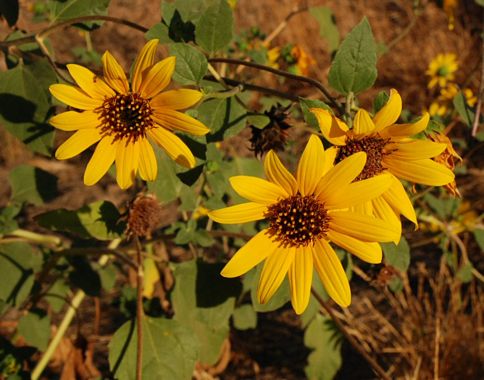
Sunflower (Helianthus annuus) is a robust annual in the Asteraceae (sunflower) family, widely seen across California. Often found in disturbed areas like road shoulders, edges of farm fields, and vacant lots, it is also a striking addition to gardens when given ample space, direct sun, and regular watering.
This plant produces stout stalks topped with large, cheerful flower heads. The flower head is a composite of numerous small florets, with outer ray florets in shades of yellow, maroon, orange, or other colors, and inner brown disc florets that mature into seeds. Horticultural varieties like 'Autumn Beauty' offer additional color variations.
Sunflowers are excellent habitat plants, offering nectar and pollen for a wide array of bees and butterflies. Their seeds are a valuable food source for birds, making them a wonderful choice for wildlife-friendly gardens.
Annual herb
5 - 10 ft Tall
2 ft Wide
Upright, Upright Columnar
Fast

Orange, Yellow, Brown
Summer
Containers
Full Sun
Low
Max 1x / week once established
Moderate
Tolerates cold to 0° F
Fast, Medium, Slow
Adaptable, tolerant of sand, loam and clay.
Soil PH: 5.4 - 8.6
After the seeds have been dispersed, the dried stalk and leaves may be chopped up for mulch
By seed
2, 3, 4, 5, 6*, 7, 8, 9, 10, 11, 12, 13, 14, 15, 16, 17*, 18, 19, 20, 21, 22, 23, 24
Disturbed places
Weed (disturbed places), Wetland-Riparian
This plant can be used with many native plants in the garden as long as they can accept regular water. A good use might be as a border between native plants and vegetables.
Butterflies and moths supported
9 confirmed and 28 likely
Ambrosia Plume Moth
Adaina ambrosiae
Ipsilon Dart
Agrotis ipsilon
California Patch
Chlosyne californica
Bordered Patch
Chlosyne lacinia