

Carried by 86 nurseries
View Availability at NurseryData provided by the participants of the Consortium of California Herbaria
View additional distribution information on the Jepson eflora
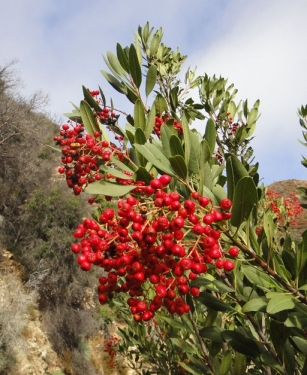
Toyon (Heteromeles arbutifolia), also known as Christmas Berry, is an evergreen shrub in the Rose family (Rosaceae). In the summer it produces bunches of fragrant white flowers. In the winter it develops vibrant clusters of scarlet berries. The flowers attract butterflies and other pollinators. The berries are eaten by many birds, including Mockingbirds, American Robins, and Cedar Waxwings. Mammals including coyotes and bears also eat and disperse the berries. For humans, the berries are edible after cooking, or drying and crushing, in order to break down the small amounts of cyanogenic glycosides. Indigenous People use the berries to make cider, and a granular sugar.
Toyon is a prominent component of the Coastal Sage Scrub plant community, and is a part of drought-adapted Chaparral, Mixed Evergreen Forest and Oak Woodland habitats. Toyon are beautiful plants and easy to grow. If properly situated, they can grow very quickly, up to 10 feet in three years. They like sun or part shade, though they tend to do better in part shade in the southern, drier part of their geographic range. They can handle a wide variety of soils, including clay, sand and serpentine. They are an excellent hedge plant.
Shrub
6 - 30 ft Tall
10 - 15 ft Wide
Rounded
Fast, Moderate
Evergreen
Slight

White
Summer
Bank stabilization, Hedge
Full Sun, Partial Shade
Very Low, Low
Max 2x / month once established, Never irrigate once established
Easy
Tolerates cold to -5° F
Fast, Medium, Slow
Tolerant of a variety of soils.
Tolerates serpentine soil..
Soil PH: 5.0 - 8.0
If it becomes leggy, you can cut it to the ground and it will regrow from the base.
For propagating by seed: Fresh seeds need no treatment; stored seed 3 mos. stratification.
5, 7*, 8, 9, 14*, 15*, 16*, 17*, 18*, 19*, 20*, 21*, 22*, 23*, 24*
Toyon is a common plant in chaparral and is found along creeksides, bottoms of slopes, north-facing slopes, and canyons.
Chaparral
Lemonadeberry (Rhus integrifolia), Manzanita (Arctostaphylos spp.), Ceanothus species, Milkweed (Asclepias spp.), Giant Wild Rye (Elymus condensatus), Sand Aster (Corethrogyne filaginifolia), Sagebrush (Artemisia californica), Monkeyflower (Mimulus spp.), Encelia californica, Buckwheat (Eriogonum spp.), Heartleaf Keckiella (Keckiella cordifolia), Penstemon species, Salvia species, Blue-eyed Grass (Sisyrinchium bellum)
Butterflies and moths supported
4 confirmed and 4 likely
Destructive Pruneworm Moth
Acrobasis tricolorella
Western Avocado Leafroller Moth
Amorbia cuneana
Pacific Azure
Celastrina echo