

Carried by 1 nurseries
View Availability at NurseryData provided by the participants of the Consortium of California Herbaria
View additional distribution information on the Jepson eflora
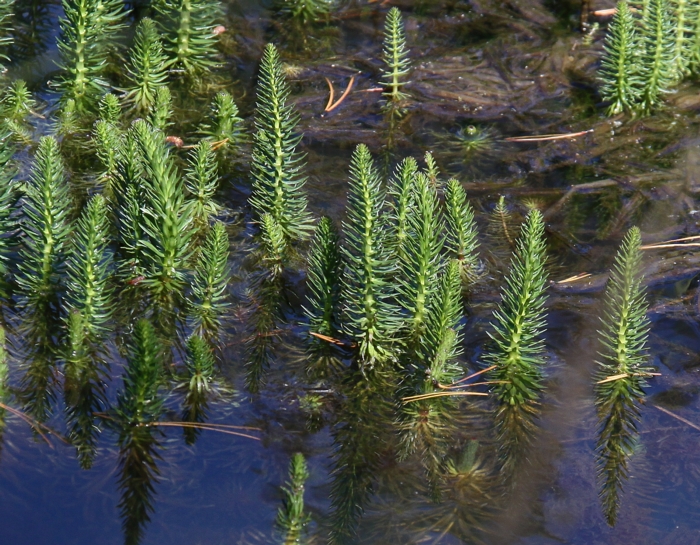
Hippuris vulgaris, known as mare's-tail or common mare's tail, is a common aquatic plant of Eurasia and North America ranging from Greenland to the Tibetan Plateau to Arizona. It prefers non-acidic waters. The species is also sometimes called horsetail, a name which is better reserved to the horsetails of genus Equisetum. These are unrelated to H. vulgaris, although there is some resemblance in appearance. The common mare's tail is a creeping, perennial herb, found in shallow waters and mud flats. It roots underwater, but most of its leaves are above the water surface. The leaves occur in whorls of 6-12; those above water are 0. 5 to 2. 5 cm long and up to 3 mm wide, whereas those under water are thinner and limper, and longer than those above water, especially in deeper streams. The stems are solid and unbranched but often curve, and can be up to 60 cm long. In shallow water they project 20-30 cm out of the water. It grows from stout rhizomes. The flowers are inconspicuous, and not all plants produce them. Studies of H. vulgaris in the Tibetan Plateau have shown that it is a prolific methane emitter. H. vulgaris's roots extend into the anoxic zone of wetland soils and create a conduit for methane produced in the anoxic zone to travel to the atmosphere. Uses. In herbal medicine, mare's tail has a number of uses, chiefly to do with healing wounds, e. g. stopping internal and external bleeding, curing stomach ulcers, and soothing inflammation of the skin. It can also be a troublesome weed, obstructing the flow of water in rivers and ditches.
Perennial herb
2 - 3 ft Tall
Upright
Fast

Green
Spring
Partial Shade
Standing
Adaptable, tolerant of sand, loam and clay.
1*, 2*, 3*, 4*, 5*, 6*, 7*, 15*, 16*, 17*
Edges of shallow ponds, springs, marshes
Chaparral, Foothill Woodland, Lodgepole Forest, Red Fir Forest, Subalpine Forest, Valley Grassland, Yellow Pine Forest, Wetland-Riparian