

Carried by 17 nurseries
View Availability at NurseryData provided by the participants of the Consortium of California Herbaria
View additional distribution information on the Jepson eflora
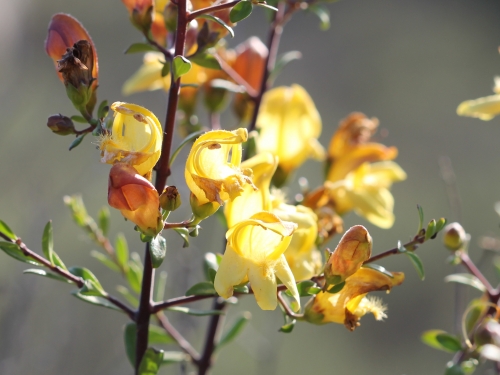
Keckiella antirrhinoides (formerly Penstemon antirrhinoides) is a species of flowering shrub in the plantain family known by the common names snapdragon penstemon and chaparral beardtongue. It is native to the chaparral, deserts, and pinyon-juniper woodlands of California, Arizona, and adjacent Baja California. This shrub grows one half to two and a half meters tall, with spreading branches. The oppositely-arranged leaves are up to 2 centimeters long and are lance-shaped or narrow ovals. They are deciduous during dry periods. The plant produces branchlike flower clusters which bear snapdragon-like flowers. Each hairy flower is about 2 centimeters wide, with three lower lobes which lie flat or curve down and two upper lobes which join to form a curved lip. Inside the flower are shiny filamentous stamens holding anthers and a flat, densely hairy sterile stamen called a staminode. The flowers are light yellow and dry to nearly black. The plant will often drop many leaves after flowering.
Shrub
2 - 7 ft Tall
2 - 4 ft Wide
Fountain, Rounded
Moderate
Summer Deciduous
Pleasant

Yellow
Spring
Deer resistant
Full Sun, Partial Shade
Low
Max 2x / month once established
Moderate
Tolerates cold to 0° F
Fast, Medium
Tolerates a variety of soils as long as adequate drainage is provided.
Soil PH: 6.0 - 7.5
For propagating by seed: No treatment. (Emery and Frey 1971).
Dry rocky slopes, canyons, and mesas of southern California primarily in Chaparral but also extending into Pinyon-Juniper Woodland and Creosote Bush Scrub
Chaparral, Creosote Bush Scrub, Pine-Juniper Woodland
Chaparral associates include California lilacs, California buckwheat, Scrub Oaks, Southern Honeysuckle (Lonicera subspicata var. subspicata), and Chaparral Yucca. Desert associates include Creosote Bush, Brittlebush and Desert Agave. Pinyon-Juniper associates include Pinus spp., California Juniper and Big Sagebrush
Butterflies and moths supported
1 confirmed and 2 likely