

Carried by 6 nurseries
View Availability at NurseryData provided by the participants of the Consortium of California Herbaria
View additional distribution information on the Jepson eflora
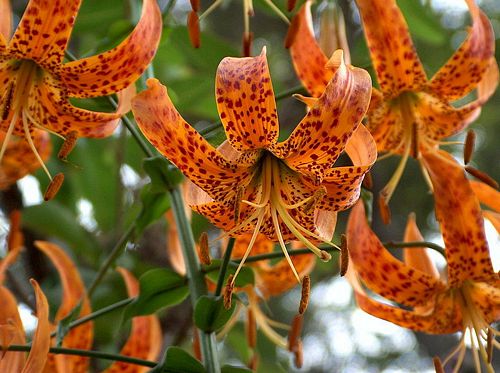
Humboldt's Lily (Lilium humboldtii) is a stunning, summer-deciduous species that can grow up to 8 feet tall. It produces large, golden-orange flowers marked with dark red or maroon splotches, blooming in June in a pyramidal cluster. The stout stems, sometimes brown-purple, support the vibrant blooms, while the shiny, green leaves grow in star-shaped whorls. After flowering, the plant dies back to its underground bulb by mid to late summer.
Humboldt's Lily thrives in shade or part sun, with soil kept moist in winter and spring. During summer, the plant should be allowed to dry out. It attracts hummingbirds and hosts one species of butterfly and moth.
There are two subspecies: ssp. humboldtii (found in the foothills of the Sierras) and ssp. ocellatum (found in southern California and the Channel Islands), both considered rare.
Perennial herb, Geophyte
6 - 8 ft Tall
1 ft Wide
Upright Columnar
Moderate
Summer Deciduous

Red, Orange, Yellow, Purple, Brown
Summer, Spring
Full Sun, Partial Shade
Very Low, Low, Moderate
Max 2x / month once established
Moderate
Medium, Slow
Tolerates clay but prefers a well drained loam.
Soil PH: 5.0 - 7.0
Can be cut back to the ground in late summer after it has gone completely dormant
For propagating by seed: Sow outdoors in summer for germination the following spring, or 3-6 mos. warm then 2-3 mos. cold stratification. Seeds may also give good germination by spring if sown outdoors in early fall. For forcing slightly green or fresh seeds: 6-8 wks. warm (70°F) stratification or until the majority of seeds have formed bulblets; then 4-6 wks. cold (about 35°FJ stratification; sow, and at 55 to 60°F leaves should be produced in 4-6 wks. (De Graaff 1951).
Moist canyons, protected places on slopes or flats, often alongside streams
Chaparral, Foothill Woodland, Yellow Pine Forest
Southern Maidenhair Fern (Adiantum capillus-veneris), Manzanita (Arctostaphylos spp.), Spice Bush (Calycanthus occidentalis), Tree Anemone (Carpenteria californica), Ceanothus species, Western Redbud (Cercis occidentalis), Dogwood (Cornus spp.), Silktassel Bush (Garrya spp.), Mallow (Malacothamnus spp.), Mock Orange (Philidelphus lewisii), Oaks (Quercus spp.), Gooseberry (Ribes spp.), ferns
Butterflies and moths supported
0 confirmed and 2 likely
Reaper Dart
Euxoa messoria
Virginian Tiger Moth
Spilosoma virginica